

Corinth is a Greek city on the Isthmus of Corinth, the narrow land bridge (now transected by a canal) connecting upper Greece to the Peloponnese, the lower part of Greece that is shaped like a hand, with a thumb and three fingers. The city was founded in the 8th Century before Christ.
A Brief Summary of the History of Corinth

Sisyphus pushing the rock up the hill
According to legend, Corinth was founded by King Sisyphus, who, in his mythical afterlife, the gods condemned to forever push an immense boulder up a hill only for it to roll back down every time it neared the top. Hence, tasks that are laborious, futile, and never-ending are often described as “Sisyphean.” Sisyphus’ grandson, Bellerophon, famously rode a winged horse, Pegasus, who became Corinth’s symbol and was featured on their coinage.
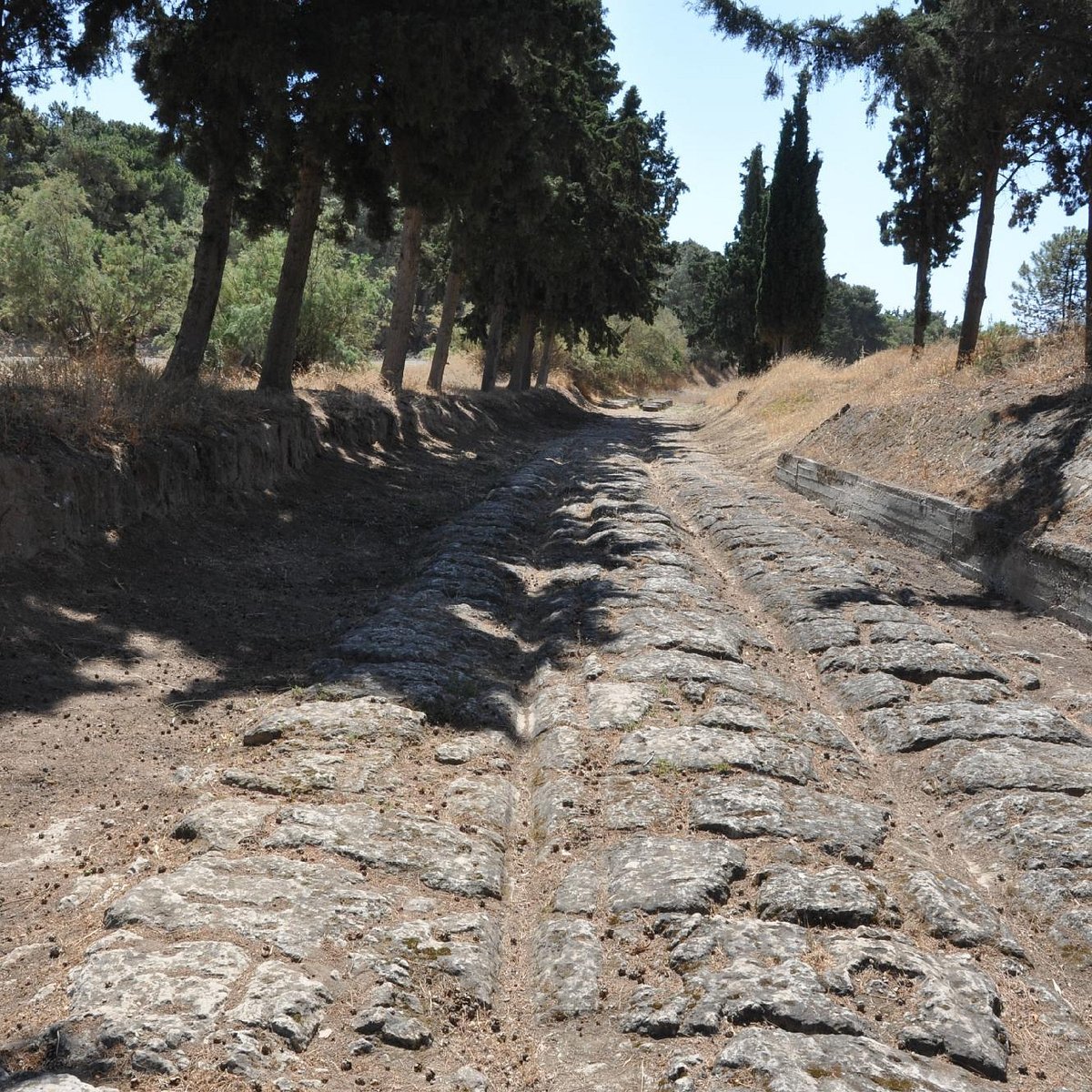
Wheel ruts of the Diolkos, the portage road across the Isthmus of Corinth
In its day, Corinth was a rival of Athens and Thebes, prospering from the Isthmian traffic. Until the modern, French-engineered canal was completed in 1893, ship captains who needed to travel from Ionian Sea on the west coast of Greece into the Aegean Sea between Greece and Asia Minor had to sail around the Peloponnese—except that there was one alternative: to have their ships ported across the five mile wide isthmus on special wheeled ship carriers, along a road called the Diolkos. Just as, today, it is more economical for ships to pay a hefty toll to cross through the Panama Canal rather than sail around the continent of South America, it was often more economical to be ported across the Isthmus of Corinth on the Diolkos than to sail around the Peloponnese. Hence the wheel ruts of the Diolkos are deep, permanent, and still very visible today.
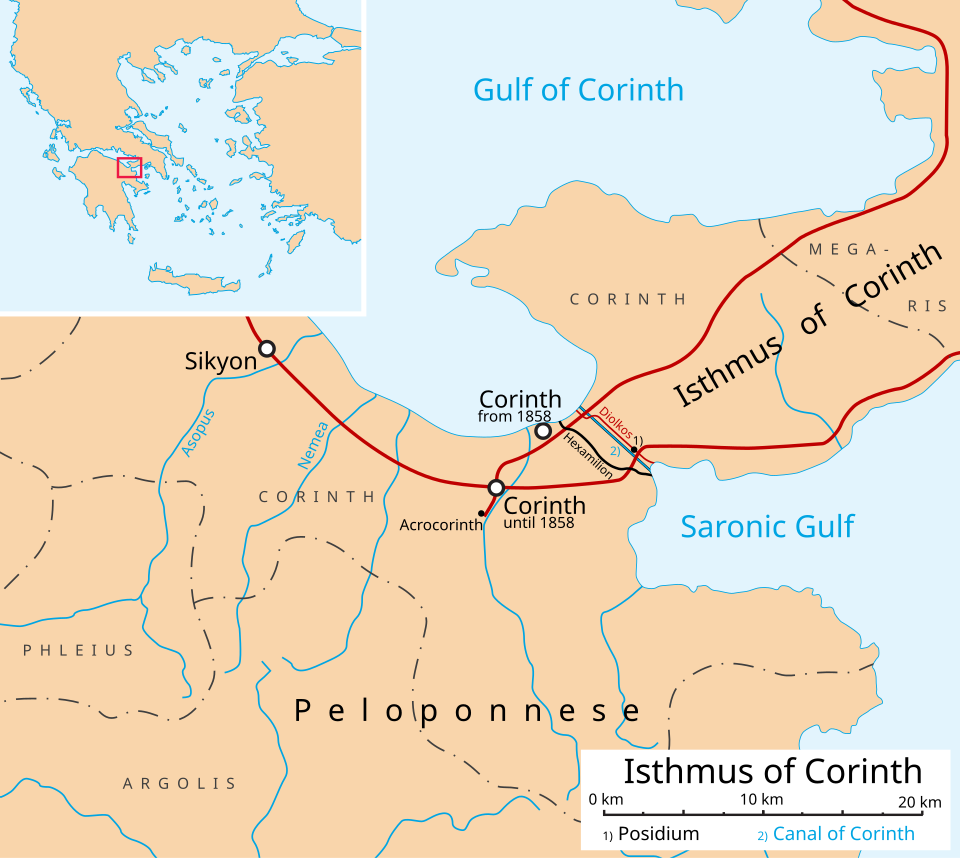
Where Corinth is located in Greece
Corinth had a temple devoted to the worship of Aphrodite, the goddess of love, which, according to the Greek geographer, Strabo, employed hundreds of temple prostitutes. Ellen White confirms that Aphrodite/Venus “was the favorite goddess; and a great number of dissolute women were employed in connection with the worship of this reigning deity, for the purpose of attracting the devotees of popular vice.” Sketches from the Life of Paul, p. 99. The city was renown for the high price of luxury goods (and luxury people); hence, it was an exclusive destination. Horace said: “non licet omnibus adire Corinthum” (“not everyone is able to go to Corinth”).
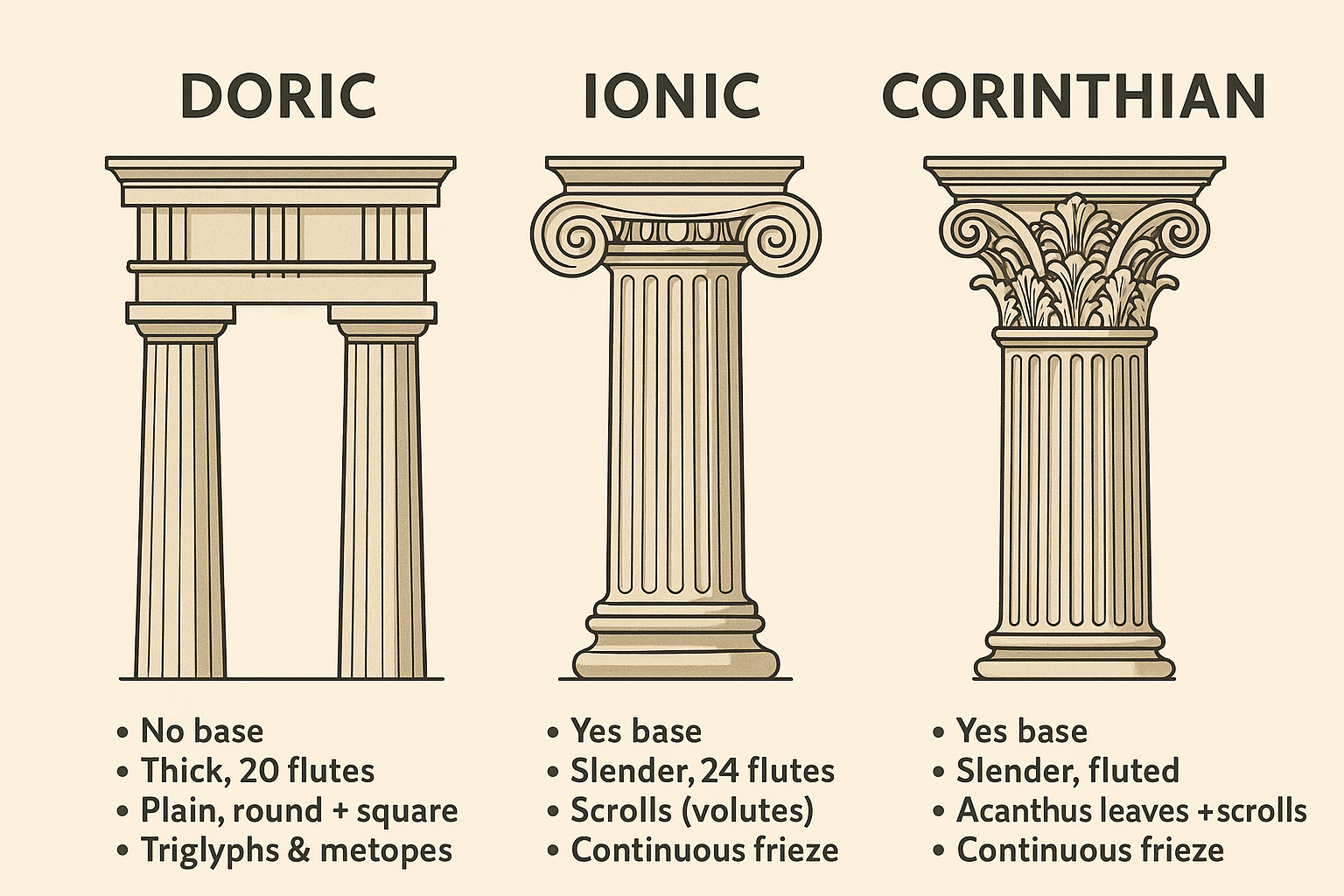
The three styles of Greek columns
During this era, Corinthians developed the Corinthian order, the third main style of Greek temple architecture after the Doric and the Ionic. The Corinthian order was the most complex and ornate of the three, highlighting the city's wealth and luxurious lifestyle.
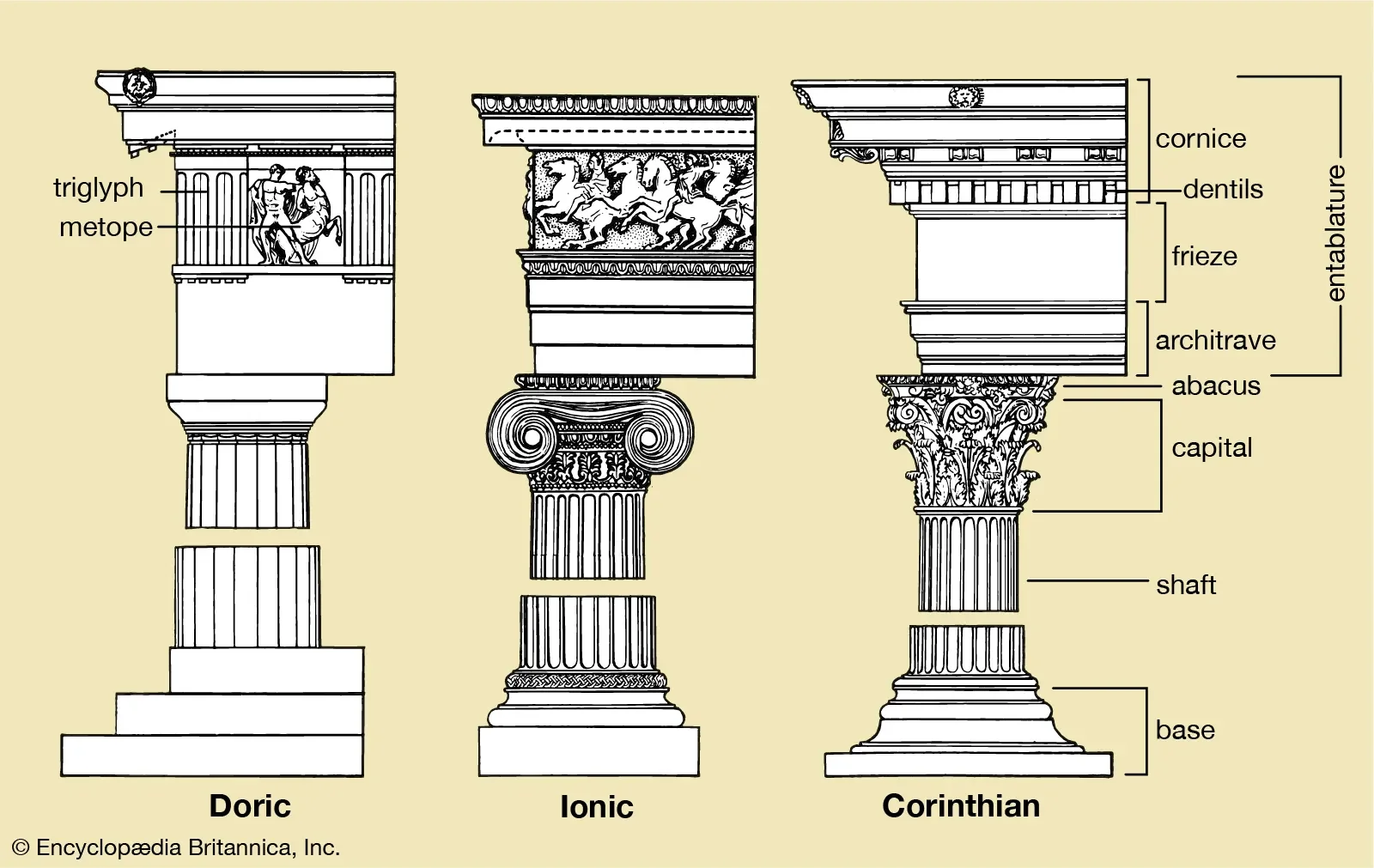
Greek temple architecture
The city had two main ports: to the west, on the Gulf of Corinth, lay Lechaion, which connected the city to its western colonies, while to the east, on the Saronic Gulf, the port of Cenchreai served the ships coming from Athens and points east. Both ports had docks for the city's navy.
In 480 BC, Corinth sent 400 soldiers to oppose the Persian invasion through Thermopylae, 100 more than its famous neighbor to the south, Sparta. Corinth also supplied forty warships for the Greek fleet at the Battle of Salamis, and 5,000 soldiers to Battle of Plataea. While Thermopylae was a noble but doomed “last stand,” the latter two Greek victories, one on the sea, one on land, forever ended the threat of invasion from Persia.
Frequent warring among the Greek city-states during the 5th and 4th Centuries before Christ weakened them all, and allowed Phillip of Macedonia to exert control over all of Greece. By 332 BC, Phillip’s son, Alexander the Great was in control of all of Greece, as hegemon. During this Hellenistic period, Corinth, like many other Greece city-states, never regained its autonomy. After Alexander, two of the dynasties founded by Alexander’s generals, the Antigonids and the Ptolemies, fought over Corinth.
Corinth later became part of the second Achaean League, a confederation established in 280 BC. The Achaean League was an attempt to apply principles of federalism to balance the Greek city-states’ strong desire for local autonomy with the need for common defense and reasonably free trade within Greece. The Achaean League eventually included the entire Peloponnese peninsula, and it established its capital at Corinth.
In 146 BC, Rome declared war on the Achaean League. A series of Roman victories culminated in the Battle of Corinth, after which the army of Lucius Mummius besieged, captured, and burned the city. Mummius killed all the men and sold the women and children into slavery. Corinth remained sparsely populated for a century, until Julius Caesar re-founded the city as Colonia Laus Iulia Corinthiensis ("colony of Corinth in honour of Julius") in 44 BC (shortly before his assassination in the Roman senate).
The new Roman Corinth became a major city with a population of more than 200,000, including many Romans, Greeks, and Jews. During the time of Paul, Corinth was much more populous than Athens, perhaps as much as five times larger. Ellen White tells us:
“Corinth was now more prosperous than Athens, which had once taken the lead. Both had experienced severe vicissitudes; but [Corinth] had risen from her ruins, and was far in advance of her former prosperity, while [Athens] had not reached to her past magnificence. Athens was the acknowledged center of art and learning; Corinth, the seat of government and trade.” Sketches from the Life of Paul, p. 98.
Paul in Corinth
Per Acts 18, Paul lived in Corinth for about a year and a half (Acts 18:11). It was in Corinth that Paul first met Aquila, originally from Pontus, in northeastern Anatolia, and his wife, Priscilla. Aquila and Priscilla were tent-makers, as was Paul, and Paul stayed with them and worked with them while he was in Corinth. This couple became devoted workers for Christ, and are mentioned six times in the New Testament.
The names Aquila and Priscilla are both Roman/Latin, but we are told that Aquila was a Jew, and that he had been forced to leave Rome when Emperor Claudius expelled the Jews from that city. The Jews have been expelled from almost everywhere they’ve ever been during the last two millennia. It has become fashionable in contemporary America to condemn Gentiles for our finite patience, and unfashionable to acknowledge, much less condemn, Jewish predation on their Gentile hosts. But Ellen White confirms that Claudius had been forced to expel the Jews from Rome:
“The same malignant spirit that actuated them in their persecution of the Son of God led them to rebel against the Roman government. They were continually creating sedition and insurrections, until they were finally driven from Rome because of their turbulent spirit. Many of them found refuge in Corinth. Among the Jews who took up their residence [in Corinth] were many who were innocent of the wrongs that prevailed among them as a people. Of this class were Aquila and Priscilla, who afterward became distinguished as believers in Christ.” Sketches from the Life of Paul, pp. 99-100 (emphasis added)
As was his custom, Paul went first to the Jews in their synagogues, and tried to convince them, using the Hebrew Scriptures, that Jesus Christ was the Messiah, and then to the Gentiles. “Every Sabbath he reasoned in the synagogue, trying to persuade Jews and Greeks.” (Acts 18:4). During this time, Silas and Timothy came from Macedonia, so Paul tasked them with gentile evangelism and “devoted himself exclusively to preaching, testifying to the Jews that Jesus was the Messiah.”
Not long ago, I wrote about how Paul and the other Apostles went first to the synagogues and explained the message of Jesus Christ out of the Hebrew Scriptures. It is this very point that dispensationalists and Christian Zionists dispute; they do not believe that Jesus can be found in the Old Testament. So it is worthwhile to share a lengthy quote from Ellen White about Paul’s approach in preaching to the Jews in their synagogues:
“He brought his hearers down through the types and shadows of the ceremonial law to Christ,—to his crucifixion, his priesthood, and the sanctuary of his ministry,—the great object that had cast its shadow backward into the Jewish age. He, as the Messiah, was the Antitype of all the sacrificial offerings. The apostle showed that according to the prophecies and the universal expectation of the Jews, the Messiah would be of the lineage of Abraham and David. He then traced his descent from the great patriarch Abraham, through the royal psalmist. He proved from Scripture what were to have been the character and works of the promised Messiah, and also his reception and treatment on earth, as testified by the holy prophets. He then showed that these predictions also had been fulfilled in the life, ministry, and death of Jesus, and hence that he was indeed the world’s Redeemer.
“The most convincing proof was given that the gospel was but the development of the Hebrew faith. Christ was to come for the special benefit of the nation that was looking for his coming as the consummation and glory of the Jewish system. The apostle then endeavored to bring home to their consciences the fact that repentance for their rejection of Christ could alone save the nation from impending ruin. He rebuked their ignorance concerning the meaning of those Scriptures which it was their chief boast and glory that they fully understood. He exposed their worldliness, their love of station, titles, and display, and their inordinate selfishness.
“But the Jews of Corinth closed their eyes to all the evidence so clearly presented by the apostle, and refused to listen to his appeals. The same spirit which had led them to reject Christ, filled them with wrath and fury against Paul. They would have put an end to his life, had not God guarded his servant, that he might do his work, and bear the gospel message to the Gentiles.” Sketches from the Life of Paul, pp. 103-104.
As always, Paul would eventually hit a brick wall with the Jews, and then shift his focus to the Gentiles. “But when they opposed Paul and became abusive, he shook out his clothes in protest and said to them, ‘Your blood be on your own heads! I am innocent of it. From now on I will go to the Gentiles.’” (Acts 18:6).
Paul’s frustration with the Jews was such that he was considering leaving Corinth, but, in a dream, God encouraged him to continue laboring where he was, and, importantly, God guaranteed his safety, because Paul understood that the Jews wanted to kill him: “‘Do not be afraid; keep on speaking, do not be silent. For I am with you, and no one is going to attack and harm you, because I have many people in this city.’ So Paul stayed in Corinth for a year and a half, teaching them the word of God.” (Acts 18:9-11).
Although he stopped going to the synagogue, Paul set up shop next door, in the home of Titius Justus whom, Scripture tells us, was “a worshiper of God.” (Acts 18:8). And Paul’s efforts on behalf of the Jews were not fruitless, because “Crispus, the synagogue leader, and his entire household believed in the Lord; and many of the Corinthians who heard Paul believed and were baptized.”
The fact that Crispus, the synagogue leader, and some others were converted further enraged the Jews:
The feelings of hatred with which many of the Jews had regarded the apostle were now intensified. The conversion and the baptism of Crispus had the effect to exasperate instead of to convince these stubborn opposers. They could not bring arguments to show that he was not preaching the truth, and for lack of such evidence they resorted to deception and malignant attack. They blasphemed the truth and the name of Jesus of Nazareth. No words were too bitter, no device too low, for them to use in their blind anger and opposition. They could not deny that Christ had worked miracles, but they declared that he had performed them through the power of Satan; and they now boldly affirmed that the wonderful works of Paul were accomplished through the same agency.” Sketches from the Life of Paul, pp. 105-106.
The Jews considered Paul a serious enough threat that they attempted a malicious prosecution in front of a Roman magistrate. It did not work:
While Gallio was proconsul of Achaia, the Jews of Corinth made a united attack on Paul and brought him to the place of judgment. “This man,” they charged, “is persuading the people to worship God in ways contrary to the law.”
Just as Paul was about to speak, Gallio said to them, “If you Jews were making a complaint about some misdemeanor or serious crime, it would be reasonable for me to listen to you. But since it involves questions about words and names and your own law—settle the matter yourselves. I will not be a judge of such things.” So he drove them off. Then the crowd there turned on Sosthenes the synagogue leader [who had apparently instigated the prosecution] and beat him in front of the proconsul; and Gallio showed no concern whatever. (Acts 18:12-17)
The wise proconsul, Gallio, would not try to sort out something that appeared to be an internal religious dispute within Judaism. It is still the law today in most Western countries that secular magistrates will not regulate issues within a denomination that bear on that denomination’s doctrine or practice. Two recent prominent examples of that principle are Our Lady of Guadalupe School v. Morrissey-Berru and Hosanna-Tabor Evangelical Lutheran Church & School v. EEOC.
Would that Pilate had been as courageous as Gallio! But then Christ said, before and after His death on the cross, that “everything must be fulfilled that is written about me.” Luke 24:44. See, also, Luke 18:31; Mark 14:49; Mat. 26:54. Christ had to die on the cross, both to fulfill the Old Testament prophecies, such as Psalm 22 and Isaiah 53, and to vouchsafe salvation to mankind.
Paul wrote at least two epistles to the church at Corinth, the two that are part of the New Testament canon. First Corinthians was written from Ephesus, and Second Corinthians was written from Macedonia. Some scholars suspect that Paul wrote at least two more, which are now lost.
