

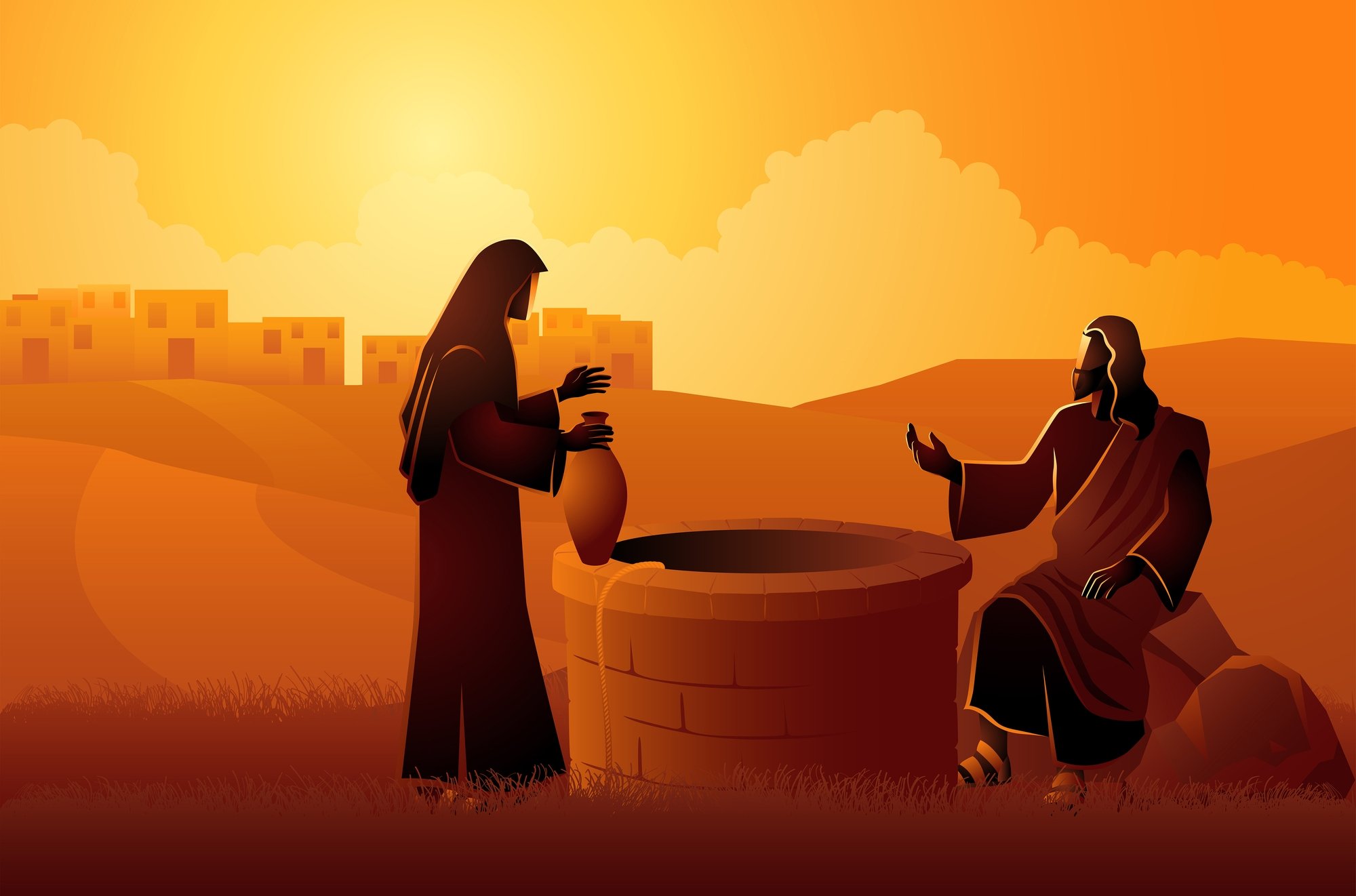
Who is the woman at the well? Crazy as this may seem at first, it’s us – the Seventh-day Adventist church.
The Background
Who are the main characters involved? Jesus, the Samaritan woman, and the people of the town of Sychar. What does a woman represent in Bible prophecy? A church. So, viewed through a prophetic lens, we can find parallels to the past, current, and future interactions of Jesus with our church and, ultimately, our church with the world as we approach the Time of the End.
Looking at the location of this story, the town’s name, Sychar, was a derogatory term used by the Jews that indicates drunkenness. Isn’t it interesting that there is a city mentioned in Revelation that is also drunken? It is that great city, Babylon, representing the great source of spiritual confusion and persecution that eventually receives the judgements of God.
And what about the well? The well contains water, the life-giving properties of which are essential for survival. In a spiritual sense, is not water like the life-giving properties of righteousness that help fulfil our spiritual desires, giving spiritual life? And considering the water and well represent righteousness, this woman is relying on her own works to obtain righteousness as she goes through the motions of drawing the water from the well with her water pot.
The time of the meeting is fascinating. This woman comes to draw water at an inconvenient time: noon. She is not coming in the cool of the day for convenience and comfort. She is at the well in the heat of the day, with the sun at its zenith, shining down with its greatest intensity and providing the greatest light. In a spiritual sense, this woman, this church, is coming to the well, the source of spiritual life, at a different time than all the other women, and Jesus is there at that moment. He is not there in the cool of the morning or evening hours, when convenience and comfort create an ideal social scene, where gossip and laughter easily fill the air. No, He is at the well when the greatest light, the greatest truth, is shed upon this woman’s lonely path. Does this not point to the Sabbath, a peculiar time for worship among the Christian denominations? Is it not an inconvenient time for business owners, employees, students taking exams, or any Sabbath keeper who has faced religious discrimination or at least had to apply for religious exemption? (Please note: The author is very thankful for religious exemption laws despite the inconvenience and added finical burden of working with the exemption. He would have faced a stalled career path without it.)
The Exchange
Jesus makes first contact, asking for a favour. The discussion quickly moves from the shock of interaction to a captivating idea that there is another way to obtain water, to obtain righteousness, one that produces lasting results and, ultimately, eternal life. The woman expresses the desire to experience this living water and avoid the toil of drawing from the well, the desire to have a permanent change to the life that avoids the works-based self-righteousness that may temporarily assuage the conscience but is as filthy rags in the eyes of God.
Having expressed this desire, Jesus then approaches her through the gift of prophecy. He captivates her attention by His knowledge of things impossible for mortals to know. Why are you an Adventist? Why do you believe that the Bible is the Word of God? What gives you hope as you look toward the future? What gives you confidence that your sins can be, and are, forgiven? Is it not in large part the “more sure word of prophecy” (2 Peter 1:19)?
In that prophetic moment, we see that this woman has been married five times and is now in an adulterous relationship. What have we been married to as a church? Have we not gone through a significant period of over-dedication to the law? Have we not preached the law until we have become as dry as the hills of Gilboa, that had neither dew nor rain? And what about the idea of the grace of God? Have we not been married to grace as the pendulum of Adventist thought swung away from the legalism of the past? And what about adultery? Do we not in current times see elements of worldly thought penetrating into some of our church organizations? Or how about accepting government money in our institutions, tying us all too tightly to the whims of whatever political party is currently at the helm of the United States? Could we not be seen as being in an adulterous relationship with the world by these trends and ties? And is not her true husband, Jesus, in front of her, speaking with her, and she doesn’t realize it yet? Is Jesus not the seventh in the list, bringing it to completion?
While the woman acknowledges Jesus’ prophetic gift, she then immediately devolves into theological controversy, sidetracking the conversation and delaying the development of a deeper relationship that Jesus wishes to give her. Have we as a church ever devolved into theological controversy? Perhaps you can think of an example or two…or seven…or ten.
Jesus gently addresses the controversy by talking about an hour, about the truth, and about worship. Are these elements not contained in the First Angel’s Message? Does not the First Angel carry the everlasting gospel of truth, proclaiming that the hour of judgment has come, and to worship Him who is the Creator? Could the Three Angels’ Messages, if focused upon and firmly believed and preached, be the cure to theological controversy that plagues our church and interrupts the deepening relationship that Jesus wants with us?
Once the First Angel, and by association the Second and Third Angels’ Messages, becomes the focal point of the exchange, the woman expresses the belief in the advent of the Messiah and the revealing of all things. Jesus responds by plainly revealing that He is the Messiah for whom she has been waiting.
The Aftermath
Then, something amazing happens. The woman leaves her water pot, she goes back into the city, that drunken city of Sychar, and calls the people out to meet Jesus, to meet the Messiah. She points to His prophetic knowledge, excitedly telling the people who she has found and what He has revealed to her, the shame of her past mistakes forgotten in the excitement of meeting Jesus.
Is not Jesus’ revelation of who He is analogous to the outpouring of Latter Rain? Does this not then create a transformation in this woman, this church, as she leaves righteousness by works behind and pivots to righteousness by faith? Is not the Loud Cry a message to “come out of her [Babylon, that drunken city] my people” (Revelation 18:4)? Is not Jesus’ promise fulfilled in this woman, this church, that she will become a well of water springing up into everlasting life, becoming a source of life for others to come to Jesus?
And what is the response? Many believe because of her word, but others only come to a belief when they have met Jesus themselves. This church will convince some people of the truth simply by their testimony, while others are convinced only once they study it out for themselves. Either way, Jesus uses this woman, this church, as the catalyst.
Summary
This woman has the following characteristics:
She comes to the well at a different time than all the other women – the Sabbath.
She is captivated by the prophetic word – historicist interpretation of prophecy, the Spirit of Prophecy given through EGW.
She has been married numerous times and is now in an adulterous relationship – the pendulum swing of theological thought and ties to worldly organizations.
She engages in theological controversy.
She responds to the Three Angels’ Messages – our core mission as a church.
She expresses a belief in the Advent of Jesus – the Second Coming.
She responds to Jesus’ revelation of Himself by pivoting away from righteousness by works to righteousness by faith – the Latter Rain.
She faithfully and dutifully returns to the drunken city and excitedly tells the people about Jesus – the Loud Cry.
She brings the people out of the drunken city to meet Jesus by the word of her testimony – fulfillment of our church’s mission.
Is this not the Seventh-day Adventist church?
This story speaks of the history, present condition, and future of our church. We are in the correct end-time church. In spite of all the things we disagree with, in spite of all the flaws we may point to in our laity or church structure or leadership, in spite of all the controversy that we may foolishly engage in, if we will focus on Jesus and our mission as found in the Three Angels’ Messages, Lord willing we may be partakers of the Latter Rain, we may see the fulfilment of our church fully engaged in righteousness by faith, fully engaged in giving the Loud Cry, and bringing many sons and daughters to Jesus.
Brothers and sisters, do not lose faith! Have courage! Look to Jesus, the author and finisher of our faith! Look to our great mission and the prophetic messages we have been given! Leave controversy behind, not compromising, but upholding the Bible truth in love, pointing the contentious to the Three Angels’ Messages! Recognize how close we are in the sequence to the Latter Rain, and thus The End! Prepare your heart to receive it! Study to show yourself approved unto God! Spread the light wherever opportunity arises!
Will you respond today?
May God bless the work and prepare our hearts.
Special thanks to Michael Maw for his contribution to the ideas and themes presented.
****

Morse Stonecypher is an orthodontist living and working in British Columbia, Canada. He attended Southern Adventist University for undergraduate studies, then Loma Linda University for dentistry and orthodontics residency. He enjoys hiking, mountain biking, skiing, photography, writing short stories, reading history, giving Bible studies, and spending time with his wife and daughters.
