

a. The Parable of the Wedding Feast
In Matthew 22:1-14, we find this parable:
And again Jesus spoke to them in parables, saying, “The kingdom of heaven may be compared to a king who gave a wedding feast for his son, and sent his servants to call those who were invited to the wedding feast, but they would not come. Again he sent other servants, saying, ‘Tell those who are invited, “See, I have prepared my dinner, my oxen and my fat calves have been slaughtered, and everything is ready. Come to the wedding feast.”’ But they paid no attention and went off, one to his farm, another to his business, while the rest seized his servants, treated them shamefully, and killed them. The king was angry, and he sent his troops and destroyed those murderers and burned their city. Mat. 22:1-7
The wedding feast is the marriage of Christ to His church. The feast celebrates the fact that Christ, the Son of God, has died on Calvary, giving His church a Redeemer, supplying us with salvation. That Christ has already died is typified by the fact that the oxen and fat calves have been slaughtered. Christ having been sacrificed, everything is now ready for the church to be united with its Savior. Christ our Passover lamb has been sacrificed for us; therefor let us keep the feast. (1 Cor. 5:7-8).
We are in the period immediately after Christ’s death, so the king’s servants, meaning the apostles, go first to the Jews: to the Jew first and then to the Greek (Rom. 1:16). But the apostles meet with persecution as witness to the Jews, typically going to the synagogues and preaching Jesus Christ as shown in the Hebrew Scriptures. It is interesting that in the parable of the vineyard, the son was killed, but here only some of the king’s servants are killed. Again, I believe this is because the parable is set after Christ’s death, so Christ is no longer in the picture. We are being directed to the final years of Israel’s probation. But the king’s servants are not accomplishing much with the Jews, and are being killed for their efforts.
So God sends “his troops” to destroy those murderers and burn their city; this is obviously the catastrophe of 70 AD. The Romans who carried out the destruction of Jerusalem are called “his troops” because God used them for His purposes. God often used pagan princes to accomplish His purposes. Just as He used Nebuchadnezzar to punish Israel (Jeremiah 34:2-3) and Cyrus the Great to restore Israel (Ezra 1:1-11), He used Titus to bring vengeance upon Israel (Luke 21:20-22; Mat. 21:41). As a denomination, we have failed to emphasize sufficiently that 70 AD marks God’s judgment, His wrath, on the failed Jewish nation, and the end of God trying to work with the Jews as a nation.
The Jewish nation having been “not worthy,” God expands the invitation to everyone, individual Jews and gentiles alike:
“Then he said to his servants, ‘The wedding feast is ready, but those invited were not worthy. Go therefore to the main roads and invite to the wedding feast as many as you find.’ And those servants went out into the roads and gathered all whom they found, both bad and good. So the wedding hall was filled with guests.” Mat. 22:8-10.
The gospel is now to go to the gentiles; in fact, the gospel is to be preached to everyone on earth, without exception. Note that “both bad and good” people are invited. This obviously means Jews and gentiles alike; pre-existing religious status makes no difference. Jews do not receive special, gilt-edged invitations because of their religious heritage; the same invitation goes out to everyone, “as many as you find.”
“But when the king came in to look at the guests, he saw there a man who had no wedding garment. And he said to him, ‘Friend, how did you get in here without a wedding garment?’ And he was speechless. Then the king said to the attendants, ‘Bind him hand and foot and cast him into the outer darkness. In that place there will be weeping and gnashing of teeth.’ For many are called, but few are chosen.” Mat. 22:11-14.
The wedding garment is the righteousness of Christ, both imputed and imparted, without which no one is admitted to heaven. (Isa. 61:10; Gal. 3:27; Rev. 7:9-14). Christ’s righteousness is the only way into heaven; law-keeping, pharisee-ism, ancestry, circumcision, tithe-paying, religiosity, etc.—none of that will ever win you God’s favor. The only way to please God is to be found wearing the robe of Christ’s righteousness.
What then of the Jews? The conceit of dispensationalism and Christian Zionism is that carnal Israel, unbelieving Jews, have a special status that runs parallel to Christianity, and does not depend upon claiming the righteousness of Jesus Christ. But the whole point of this parable—which Jesus told during the passion week, shortly before his death—is that Jew and gentile alike depend entirely upon the righteousness of Christ. Anyone not wearing the wedding garment is bound hand and foot and thrown out of the wedding feast. The Jews have no separate special status that stands upon the flesh, upon ancestry, upon pharisee-ism, upon law-keeping, or anything else. If you belong to Christ, then you are Abraham’s seed, and heirs according to the promise. Gal. 3:29
b. Driving the Moneychangers from the Temple
The story of Jesus driving the moneychangers from the temple is found in the same part of the gospels as cursing the fig tree, the parable of the vineyard, the parable of the two sons, all of which cut strongly against dispensationalism and Christian Zionism.
In the middle of these parables, we find Christ driving the moneychangers from the temple. This story is briefly told in all three of the synoptic gospels, but Mark, who was writing for a gentile audience—the Romans—includes something (which I’ve put in bold italics) Matthew and Luke leave out:
And they came to Jerusalem. And he entered the temple and began to drive out those who sold and those who bought in the temple, and he overturned the tables of the moneychangers and the seats of those who sold pigeons. And he would not allow anyone to carry anything through the temple. And he was teaching them and saying to them, “Is it not written, ‘My house shall be called a house of prayer for all the nations’? But you have made it a den of robbers.” Mark 11:15-17 (emphasis added)
The temple in Jerusalem was to have been “a house of prayer for all nations,” not just the Jewish nation. The outer court was reserved for the gentiles, and was called “the court of the gentiles.” Any gentiles who so desired were supposed to be allowed to pray there. Gentiles were in the same category—unclean—as an Israelite who, by reason of birth defect, disease, or other physical infirmity, was considered unclean.
But even the “unclean” gentiles and defective Jews were allowed on the temple grounds to pray in the Outer Court. That the gentiles should have access to the temple was already, in Christ’s day, an ancient principle. In fact, Christ was quoting Isaiah:
“And the foreigners who join themselves to the Lord,
to minister to him, to love the name of the Lord,
and to be his servants,
everyone who keeps the Sabbath and does not profane it,
and holds fast my covenant--
these I will bring to my holy mountain,
and make them joyful in my house of prayer;
their burnt offerings and their sacrifices
will be accepted on my altar;
for my house shall be called a house of prayer
for all peoples.” Isaiah 56:6-7
Isaiah says not only that the temple shall be a house of prayer for all nations, but that the sacrifices and offerings of gentiles should be accepted on the altar of the temple!
Isaiah’s dream was far beyond anything the Jews of Christ’s time would tolerate. Gentiles were strictly forbidden, on pain of death, from going into the area where sacrifices were made. Archaeologists have found tablets in Jerusalem that warn in Greek and Latin:
“No alien may enter within the balustrade around the sanctuary and the enclosure. Whoever is caught [in that area], on himself shall he put blame for the death which will ensue.”
The multi-year saga that ended with Paul’s house arrest in Rome began when he was accused of bringing Gentiles into the inner sanctuary (Acts 21:28). (Not that Paul should have been doing what he was doing.)
We can go back even further than Isaiah. Here is what Solomon prayed when he dedicated his monumental temple, around 960 BC:
“Likewise, when a foreigner, who is not of your people Israel, comes from a far country for your name's sake (for they shall hear of your great name and your mighty hand, and of your outstretched arm), when he comes and prays toward this house, hear in heaven your dwelling place and do according to all for which the foreigner calls to you, in order that all the peoples of the earth may know your name and fear you, as do your people Israel, and that they may know that this house that I have built is called by your name.” 1 Kings 8:41-43
Then, in his benediction, Solomon said this:
“Let these words of mine, with which I have pleaded before the Lord, be near to the Lord our God day and night, and may he maintain the cause of his servant and the cause of his people Israel, as each day requires, that all the peoples of the earth may know that the Lord is God; there is no other.” 1 Kings 8:59-60 (emphasis added).
The aspirations of Solomon and Isaiah notwithstanding, somewhere down the centuries, any obligation that the Jews had felt to reach out to the gentiles had shriveled away almost to nothing, while, over those same centuries, a profound prejudice against gentiles waxed stronger and stronger.
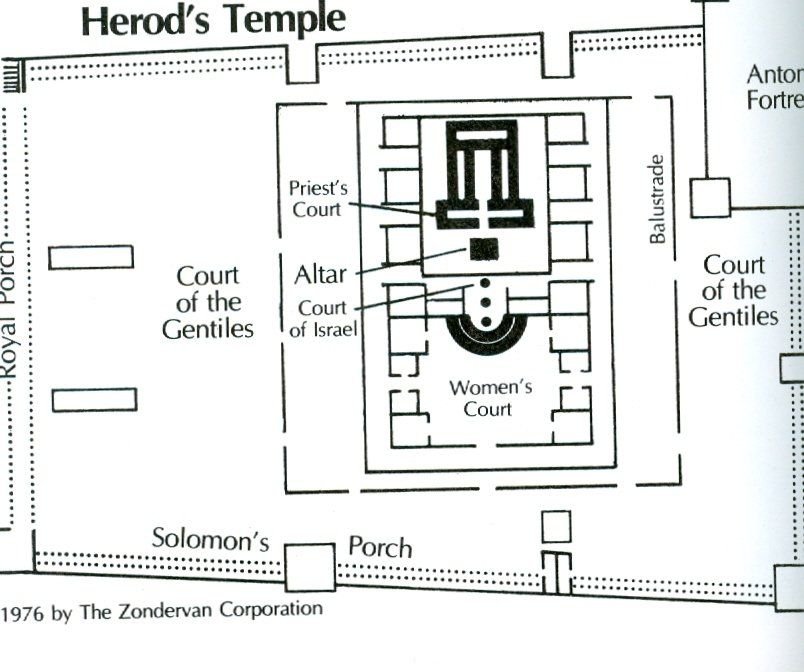
The immediate problem, for any gentile wanting to pray in the outer court, was that the Jews had turned it into a stockyard:
“The outer court of the temple was like a vast cattle yard. With the cries of the animals and the sharp chinking of coin was mingled the sound of angry altercation between traffickers, and among them were heard the voices of men in sacred office. The dignitaries of the temple were themselves engaged in buying and selling and the exchange of money. So completely were they controlled by their greed of gain that in the sight of God they were no better than thieves.” Desire of Ages, p. 589
How could anyone pray in all this racket and confusion, amidst the cattle and sheep dung, and the rivulets of animal urine? The Jews were effectively preventing gentiles from worshiping at the temple.
Yes, the moneychangers were stealing; yes, the corrupt priests and Levites were raking their cut off the top. But there was also this: this corrupt system was destroying the ability of gentiles to worship in the outer court of the temple, and “my house shall be called a house of prayer for all nations.” So Jesus drove them out.
Here is the bottom line: by the time of Christ, the Jews had become a serious obstacle to gentiles who were being drawn to the one true God, the God of Abraham, Isaac, and Jacob. As Jesus said: “But woe unto you, scribes and Pharisees, hypocrites! for ye shut up the kingdom of heaven against men: for ye neither go in yourselves, neither suffer ye them that are entering to go in.” (Matthew 23:13). They wouldn’t go in themselves, nor would they allow others to go in. They had to be taken out of the way, and they were.
