

What Religious Liberty Means to Jonathan “Blue Laws” Berry
It is with a perplexing mix of feelings I greeted the news the U.S. Senate voted to advance Jonathan Berry’s nomination to serve as the Solicitor for the Department of Labor on Friday.[1]
I am aware of his recent written advocacy for “Blue Laws” even aside from his more well-known “Department of Labor and Related Agencies” section in “Mandate for Leadership: The Conservative Promise” (aka Project 2025):
It is possible that society could spontaneously address this need for communal rest without state intervention, like it’s possible that we could have traffic safety without mandates to drive on the right side of the road. Possible, but not plausible. The revival of “blue laws” and other measures to guard Sabbath rest is thus one more example of a prudent policy intervention to protect the subjectivity, the personhood, of workers.[2]
He made similar verbal statements at a Catholic Information Center event last November: “Something I’d really encourage; it’s hard to see a big Federal role for this; it’s really a question of state and local law, [it] is reinvigorating—where possible—Sabbath rest laws….”[3]
On the other hand, he clearly stated his intentions to defend religious liberty at a June 18, 2025, Senate hearing when he stated, “I will absolutely support robust protections for religious liberty….”[4]
I wonder why Berry, as a complex human with various motivations is engaging in what some may consider to be a high level of cognitive dissonance? Is he trying to promote religious liberty at the same time as Blue Laws? Does he not see the clear contradiction of the logical extension at both ends of his proposals?
Covid-19
During the doldrums of the COVID panic and facing an employer mandate forcing acceptance of an experimental medical intervention with dubious efficacy and unquantified risks, I chose the path I believed was consistent with my religious beliefs but would likely result in my termination. After prayerfully counting the cost, I submitted a request for reasonable accommodation for religious reasons and joined with thousands of other Federal employees and their families looking for advocacy and support to form “Feds for Medical Freedom (FMF).” FMF, shortly thereafter, hired the law firm Boyden Gray & Associates (later renamed Boyden Gray PLLC), whose team of talented attorneys including managing partner, Jonathan Berry,[5] successfully sued the Biden Administration, securing a nationwide injunction which prevented the enforcement of the Federal Employee Vaccine Mandate. Berry and his team persistently defended against government appeals all the way through to the Supreme Court of the United States,[6] and settled with prospective (future) relief, a major victory for religious liberty in early 2025.[7]
So, inquiring minds—especially distinctive religious minorities who recognize the biblical Saturday Sabbath for our religious rest day—want to know: what is Berry’s understanding of religious liberty and how does he reconcile his advocacy for Sunday observance laws with his support for religious liberty?
Amidst these concerning developments lies the historic shadow of illiberal efforts in our nation in the late 1800s to enforce the observance of Sunday as a religious rest day[8] and what we believe as Seventh-day Adventists to be future—maybe imminent—(near-future?) efforts to renew similar enforced religious practice by government mandate.[9]
Perhaps we could gain some clarity from examining the Project 2025 section authored by Berry, to see his framing of the Sunday observance laws and his understanding of religious liberty. As with all things, personally engaging with content by reading or viewing primary sources is far superior to merely reviewing edited passages or clipped soundbites—or worse yet—secondhand missives by profit-driven internet panic-mongers.
First off, it should be noted the section in question by Berry is comprised of 37 pages, beginning on page 581. The ideas he asserts and the proposals he promulgates vary widely from dull to banal subjects such as reducing work visa fraud to reforming employee pension plans. Prior to addressing the paragraph that is currently being passed around online, let’s consider the context by reviewing this section containing several very clear proposals to protect religious liberty in the workplace:
Provide robust protections for religious employers. America’s religious diversity means that workplaces include people of many faiths and that many employers are faith-based. Nevertheless, the Biden Administration has been hostile to people of faith, especially those with traditional beliefs about marriage, gender, and sexuality. The new Administration should enact policies with robust respect for religious exercise in the workplace, including under the First Amendment, the Religious Freedom Restoration Act of 1993 (RFRA), 8 Title VII, and federal conscience protection laws.
Issue an executive order protecting religious employers and employees. The President should make clear via executive order that religious employers are free to run their businesses according to their religious beliefs, general nondiscrimination laws notwithstanding, and support participation of religious employees and employers as federal contractors and in federal activities and programs.
Clarify Title VII’s religious organization exemptions. Congress should clarify Title VII’s religious organization exemptions to make it more explicit that those employers may make employment decisions based on religion regardless of nondiscrimination laws.
Provide Robust Accommodations for Religious Employees. Title VII requires reasonable accommodations for an employee’s sincerely held religious beliefs, observances, or practices unless it poses an undue hardship on the employer’s business. These accommodation protections also apply to issues related to marriage, gender, and sexuality.[10]
Notice the laudable religious liberty protections in these top-line bullet points at the beginning of the section labeled “RELIGION,” under which, three pages later can be found the following section which has rightly been the cause for recent concern:
Sabbath Rest. God ordained the Sabbath as a day of rest, and until very recently the Judeo-Christian tradition sought to honor that mandate by moral and legal regulation of work on that day. Moreover, a shared day off makes it possible for families and communities to enjoy time off together, rather than as atomized individuals, and provides a healthier cadence of life for everyone. Unfortunately, that communal day of rest has eroded under the pressures of consumerism and secularism, especially for low-income workers.
Congress should encourage communal rest by amending the Fair Labor Standards Act (FLSA) to require that workers be paid time and a half for hours worked on the Sabbath. That day would default to Sunday, except for employers with a sincere religious observance of a Sabbath at a different time (e.g., Friday sundown to Saturday sundown); the obligation would transfer to that period instead. Houses of worship (to the limited extent they may have FLSA-covered employees) and employers legally required to operate around the clock (such as hospitals and first responders) would be exempt, as would workers otherwise exempt from overtime.
Alternative View. While some conservatives believe that the government should encourage certain religious observance by making it more expensive for employers and consumers to not partake in those observances, other conservatives believe that the government’s role is to protect the free exercise of religion by eliminating barriers as opposed to erecting them. Whereas imposing overtime rules on the Sabbath would lead to higher costs and limited access to goods and services and reduce work available on the Sabbath (while also incentivizing some people—through higher wages—to desire to work on the Sabbath), the proper role of government in helping to enable individuals to practice their religion is to reduce barriers to work options and to fruitful employer and employee relations. The result: ample job options that do not require work on the Sabbath so that individuals in roles that sometimes do require Sabbath work are empowered to negotiate directly with their employer to achieve their desired schedule.[11]
While I disagree with two main premises implicit in this section, namely the use of “Sabbath” to mean “Sunday,” which is an unbiblical false doctrine, and the assumption that historical government power exertions to enforce religious observance have been appropriate public policy, I would highlight the fact that Berry explicitly provides for religious accommodations of his proposals for biblical Sabbath observers in the second paragraph (“Friday sundown to Saturday sundown”).
This is not a broadly applicable universal Sunday law, as some would have us believe, but merely a recommendation to Congress to bring policies related to hourly-wage employees[12] in line with what Federal employees have already been entitled to by law since 1966.[13] Perhaps it may be an incremental step in an alarming but anticipated direction by a Catholic government bureaucrat. But much like the election of John F. Kennedy, our nation’s first Catholic president, or the elevation of Francis, the first Jesuit pope, where sensationalized claims about what these two individuals would accomplish never materialized, overwrought prognostications often lead to diminished credibility.
While we are thinking about Berry, it is a good time to remind each other to pray fervently that he and his family will come to a full understanding of the true gospel of Jesus Christ that does not compel penance but calls us to accept His atonement which is freely given. I ask you to join me in praying the Holy Spirit will relentlessly pursue him until he repents.
And let’s remember, God is still on His throne, the same as He was yesterday, and He will prevail in the end.
****
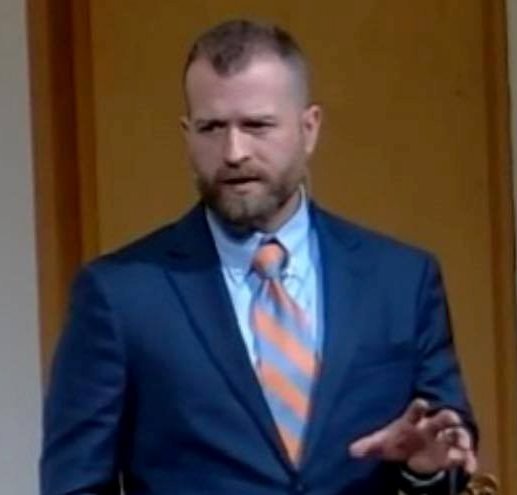
Brandon Law
Brandon Law is employed in law enforcement and practices law on the side in North Idaho, where he lives with his wife of 21 years and their three teenagers.
[1] Meade, Shannon, et al. “Policy Week in Review – October 3, 2025.” Littler, 3 Oct. 2025, www.littler.com/news-analysis/asap/policy-week-review-october-3-2025#:~:text=Earlier%20today%2C%20the%20Senate%20voted,Hour%20Division%20administrator%3B%20Jonathan%20Berry. Accessed 5 Oct. 2025.
[2] Berry, Jonathan. “Renewing Labor.” First Things, 13 Feb. 2025, www.firstthings.com/renewing-labor/. Accessed 5 Oct. 2025.
[3] Berry, Jonathan. “Renewing Labor, Catholic Information Center Washington D.C.” YouTube, YouTube, 20 Nov. 2024, www.youtube.com/watch?v=9vc4_5ydsUw. Accessed 5 Oct. 2025. Skip to minute 37 for this quote. For further event details, see: https://cicdc.org/event/renewing-labor/. Accessed 5 Oct. 2025.
[4] Berry, Jonathan. “Hearings to Examine the Nominations of Jonathan Berry, of Maryland, to Be Solicitor, Andrew Rogers, of Virginia, to Be Administrator of the Wage and Hour Division, and Anthony D’Esposito, of New York, to Be Inspector General, All of the Department of Labor, and Andrea Lucas, of Virginia, to Be a Member of the Equal Employment Opportunity Commission. | Congress.Gov | Library of Congress.” Congress.Gov, 18 June 2025, www.congress.gov/event/119th-congress/senate-event/337073 Skip to 1:16:28 for this quote. Accessed 5 Oct. 2025.
[5] “Jonathan Berry, Managing Partner.” Boyden Gray PLLC, 26 Jan. 2025, www.boydengray.com/our-team/jonathan-berry/. Accessed 5 Oct. 2025.
[6] “Feds for Medical Freedom v. Biden.” Opposition Brief, 23 Aug. 2023, www.supremecourt.gov/DocketPDF/23/23-60/276052/20230823165322267_23-60%20Brief%20in%20Opposition.pdf. Note Berry’s name listed in attorneys of record. Accessed 5 Oct. 2025.
[7] Staff, Boyden Gray. “DOJ Settles Boyden Gray’s COVID Vaccine Lawsuit.” Boyden Gray PLLC, 26 Aug. 2025, www.boydengray.com/doj-settles-boyden-grays-covid-vaccine-lawsuit/. Accessed 5 Oct. 2025.
[8] Rupert, Bethany. “The Sunday Rest Bill and the Battle to Keep the Civil Sabbath.” Seton Hall University, 3 Nov. 2015, www.scholarship.shu.edu/cgi/viewcontent.cgi?article=1084&context=shlj. Accessed 5 Oct. 2025.
[9] White, Ellen. The Great Controversy, Pacific Press Publishing Association, Boise, Idaho, 1950, pp. 579–580. “The assertion that God’s judgments are visited upon men for their violation of the Sunday-sabbath, will be repeated; already it is beginning to be urged. And a movement to enforce Sunday observance is fast gaining ground.”
[10] “2025 Mandate for Leadership: The Conservative Promise.” Scribd, Scribd, 2023, www.scribd.com/document/683516238/2025-MandateForLeadership-FULL p. 585-86. NOTE: Document download is recommended for ease of review. Accessed 5 Oct. 2025.
[11] Id. at 589.
[12] “The Fair Labor Standards Act (FLSA) Exemption for Executive, Administrative, and Professional (EAP) Employees | Congress.Gov | Library of Congress.” Congress.Gov, www.congress.gov/crs-product/IF12480. Accessed 5 Oct. 2025.
[13] “Federal Employees Salary Act of 1966.” Congress.Gov, www.congress.gov/89/statute/STATUTE-80/STATUTE-80-Pg288.pdf. Accessed 5 Oct. 2025. NOTE: Sunday Premium Pay differential is 25% more for shifts that begin or end on Sunday.
