

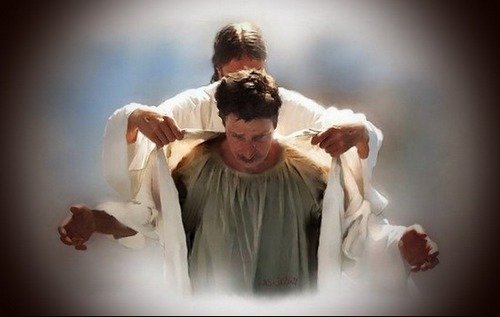
One of the most remarkable chapters in all the writings of Ellen G. White is found near the end of her book Christ’s Object Lessons, titled “Without a Wedding Garment.” In some 38 paragraphs White shares powerful insights about righteousness by faith—insights that are less and less appreciated. My aim is in a series of articles to highlight some of those insights.
You will find the parable of the wedding garment at Matthew 22:1-14. Parables can be perilous; uninspired interpreters often make too much of sidelines and may miss the main emphasis. Not every element in a parable is intended to carry the full weight of reality. Most often a parable has one main point. In this case, those 14 verses highlight the graciousness of the king and the indifference of the subjects (v. 3).
But in our case we have an inspired writer who is drawing insights from the inspired Bible writer. She introduces her topic carefully. “The parable of the wedding garment opens before us a lesson of the highest consequence” (307). She is not giving us a careful biblical exegesis of these 14 verses. She is rather letting the parable of the wedding garment serve as an anchor for the lesson and lessons she intends to share.
Her overview is: “By the marriage is represented the union of humanity with divinity; the wedding garment represents the character which all must possess who shall be accounted fit guests for the wedding.”
Marriage is indeed a remarkable symbol of union. Attendance at the wedding was predicated on condition. But there are different kinds of conditions. There are necessary conditions and sufficient conditions. A sufficient condition, when met, is in itself sufficient to bring into being a contract or a covenant. But some agreements may require meeting several necessary conditions to satisfy the contract.
In our case, the king sets necessary conditions, and, provides the needed garments: “For every guest at the feast there had been provided a wedding garment. This garment was a gift from the king.”(308) The king set the wedding. The king invited the guests. The king provided the special wedding garment to be worn to the wedding. You needed an invitation to get in. You were expected to wear the wedding garment provided.
Many would want to stop right there. Everything is provided; now, its happy ending time. But if we skip ahead to paragraph 24, we read:
“Satan had claimed that it was impossible for man to obey God’s commandments; and in our own strength it is true that we cannot obey them. But Christ came in the form of humanity, and by His perfect obedience He proved that humanity and divinity combined can obey every one of God’s precepts.”
Jesus “proved” that humanity and divinity combined can obey every one of God’s precepts. This is a remarkable statement, for, taken side-by-side with the first paragraph in the chapter, it shows that however humanity and divinity are blended in Christ, mechanically, the operation of the two is effectively the same for every follower of Christ. We overcome as Christ overcame.
Notice that in this chapter that the focus is not on legality but on character. There is a “character which all must possess who shall be accounted fit guests for the wedding.” The character as discussed is not merely counted or imagined but “possessed” by the individual, who is “accounted fit.” Consider these lines about character:
He [the Christian] should be taught that he is not merely to be saved by Christ’s sacrifice, but that he is to make the life of Christ his life and the character of Christ his character (Christ’s Object Lessons, p. 58).
and
Now is the time to entreat that souls shall not only hear the word of God, but without delay secure oil in their vessels with their lamps. That oil is the righteousness of Christ. It represents character, and character is not transferable. No man can secure it for another. Each must obtain for himself a character purified from every stain of sin (Testimonies to Ministers, p. 233).
This helps us understand why she does not simply say “accounted righteous” but rather, “accounted fit.” She is telling us that the character of each person will be accurately assessed. We are not saved by merit from our character; no merit whatever is generated by the human agent. We are saved entirely by the merits of Christ. And yet, when we draw close to Jesus as it is our privilege to, the result will be such transformation that God will be glorified.
What did Jesus do? He demonstrated in superlative degree the union of divinity with humanity. Our salvation is unequivocally from Him. To us is given the privilege of demonstrating in lessor degree the union of humanity and divinity. We will never feel we have arrived or attained to glory in our own strength. But we, all unworthy, will receive, if we open our minds and hearts, the gifts of Jesus.
****
