

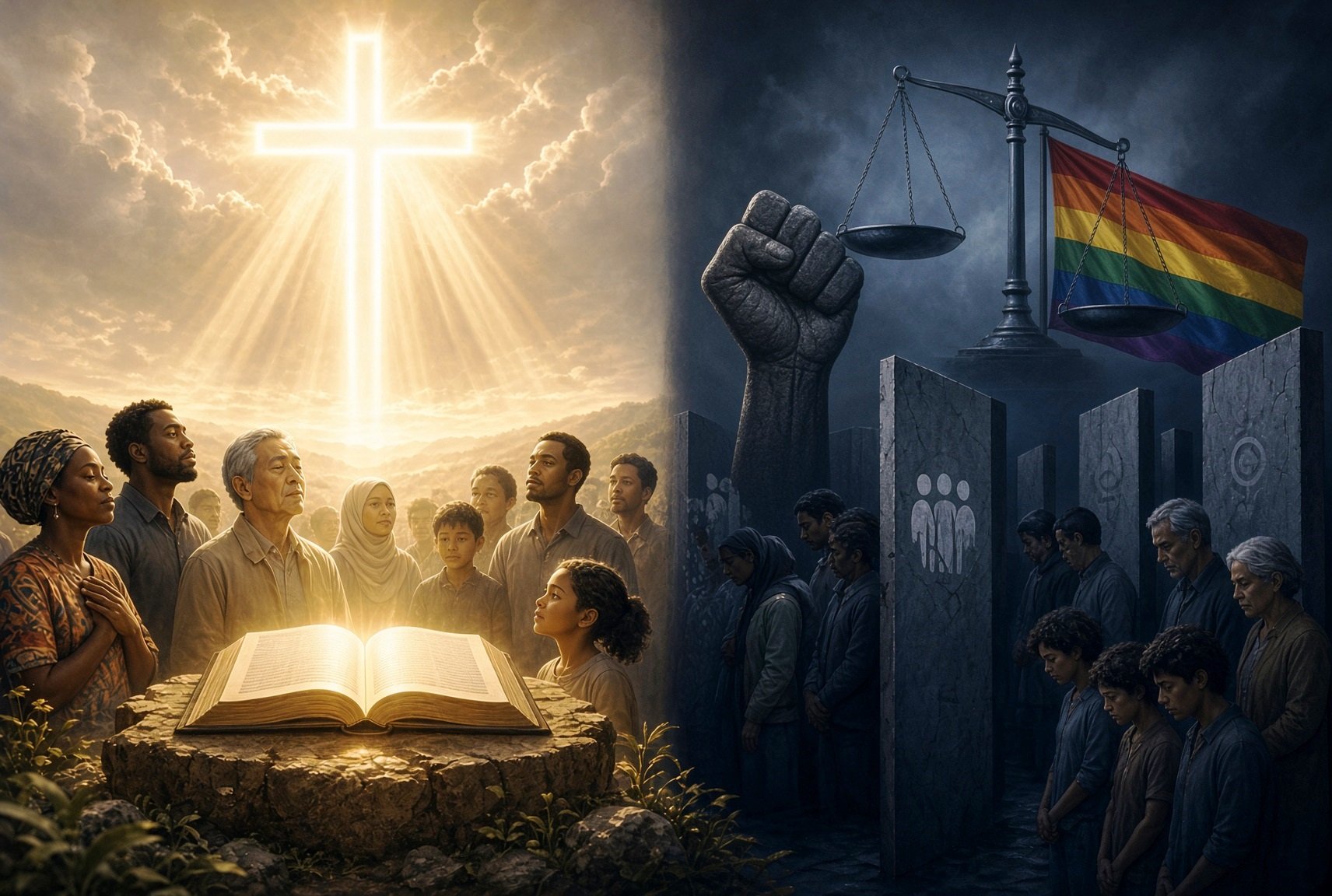
Like a smooth criminal, social justice has crept quietly into the church, carrying with it another gospel, one shaped less by Jesus and His apostles than by Karl Marx and his followers.
Many describe the economic horrors of Marxism and its butcher's bill of mass murder, but few recognize the millions of souls this godless ideology has led astray from Jesus and lost for eternity.
Beneath the unassailable name of "social justice" lies a different gospel, and since there is no gospel but the one Paul received "by the revelation of Jesus Christ" (Galatians 1:11–12), this one can only be a forgery, and a fatal one at that.
In Parts 1 and 2 of this series, we saw that the gospel unites while social justice divides, and that the gospel forgives while social justice keeps score. Now we turn to a third contrast that goes to the very heart of the Adventist message: righteousness by faith, the truth of how a sinner is made right with God.
3. The Gospel Gives Righteousness by Faith: Social Justice Assigns It
The everlasting gospel justifies all who believe in Christ, regardless of race, gender, or class (Romans 3:21–28; Galatians 2:16; Philippians 3:9). The Bible teaches that "all have sinned and fall short of the glory of God" (Romans 3:23, NKJV). Yet God, in His mercy, exchanges our filthy rags for Christ's robe of righteousness (Isaiah 64:6; 61:10). This glorious exchange takes place as we repent of our sins and place our complete trust in Jesus Christ, our Substitute and Sin Bearer (Romans 1:16–17; 2 Corinthians 5:21).
Social justice offers a very different kind of righteousness, one that depends on which of two groups a person is arbitrarily assigned to by race, gender, class, religion, and even sexuality. Those labeled "oppressors" carry a collective guilt, while those labeled "oppressed" are granted greater moral authority.
Flirting with Blasphemy
A social justice teaching known as standpoint epistemology gives some folks a false sense of righteousness, along with a license to silence those who disagree with them.
Developed by feminist scholars such as Nancy Hartsock and Sandra Harding, and applied to race by Patricia Hill Collins, it teaches that oppressed groups possess a special insight into injustice that others cannot share. To some extent this is true, for every person's experience is unique, and unless we have walked the same road, we cannot honestly say, "I know how you feel."
Many, however, carry the theory further, claiming to discern hidden bigotry in the words and motives of anyone assigned to the oppressor group. Such a claim presumes an ability Jesus reserved for Himself:
"I am He who searches the minds and hearts. And I will give to each one of you according to your works" (Revelation 2:23, NKJV).
Any teaching that credits certain groups with an ability to read the hearts and motives of others flirts with blasphemy, for it does what Jesus' accusers charged Him with doing: "thou, being a man, makest thyself God" (John 10:33). The charge was false of Christ, who is God, but it is true of any mortal who claims to read hearts. As Father Cavanaugh tells the young hopeful in the film Rudy (1993), "In thirty-five years of religious study, I have only come up with two hard, incontrovertible facts: there is a God, and I'm not Him."
Kafka Trap
Ironically, a movement that claims to champion justice denies a fair hearing to those it presumes to be oppressors, dismissing their words and discounting their experiences before they are even heard. Phrases such as "check your privilege," "your job is to listen and learn," and "impact matters more than intent" often end a conversation before it can begin, and in Robin DiAngelo's framework, even a white person's disagreement can be taken as proof of his "white fragility."
Critics call this a “Kafka trap.” In such a trap, the accusation proves itself, for whoever admits the charge is guilty, and whoever denies it is guiltier still. No court of law would tolerate such reasoning, since it overturns the presumption of innocence, silences the accused, and leaves him no way to clear his name except by confessing to a sin he never committed.
Yet Scripture warns, "The first one to plead his cause seems right, until his neighbor comes and examines him" (Proverbs 18:17, NKJV). When the Jewish priests sought to condemn Jesus without a hearing, Nicodemus asked, "Doth our law judge any man, before it hears him, and know what he doeth?" (John 7:51). Justice that hears only one side is no justice at all.
Common to Man
Social justice advocates often claim that only white people can be racist, because, by their definition, racism requires both prejudice and the power to enforce it, a formula that goes back to Patricia Bidol-Padva's Developing New Perspectives on Race (1970). The traditional definition, however, describes racism as "a belief that race is a fundamental determinant of human traits and capacities and that racial differences produce an inherent superiority of a particular race" (Merriam-Webster), and that is a sin anyone of any color can commit.
Redefining racism this way singles out one race as uniquely depraved, granting a false righteousness to some and an undeserved, unverified condemnation to others. Moreover, it contradicts Scripture, which teaches that "no temptation has overtaken you except such as is common to man" (1 Corinthians 10:13, NKJV, emphasis mine). Racism is a universal sin that can poison any heart, whatever a person's race or background. Thankfully, the gospel offers a sure antidote to racial prejudice, for "the love of God has been poured out in our hearts by the Holy Spirit who was given to us" (Romans 5:5, NKJV).
Whiteness or White People?
Much social justice rhetoric carries an unmistakable anti-white tone. To escape the charge of racism, however, advocates of critical theory are quick to claim that their criticism targets "whiteness," not white people. But few are fooled by this, and the distinction collapses in practice. Rutgers professor Brittney Cooper illustrated this at a 2021 forum on critical race theory, predicting that "whiteness is going to have an end date," and adding that "white folks are not infinite and eternal" (The Root, September 2021). Notice how quickly "whiteness" turned into "white folks," the very people we were told were not the target.
Singling out one race in this way is no accident, for a righteousness built on group identity always needs someone to look down on, much like the Pharisee who prayed, "God, I thank thee, that I am not as other men are" (Luke 18:11). It is the oldest bully tactic of all, and it shows itself whenever every racial disparity is blamed on whites, "whiteness," "white supremacy," or whatever bigoted label its advocates choose.
Let's not sugarcoat it: social justice is a racist ideology, for it judges people by the color of their skin, and has no business in the Seventh-day Adventist Church, a movement called to love, serve, and lead "every nation, and kindred, and tongue, and people" to Christ (Revelation 14:6).
Anti-West
Because Western nations are largely white and rooted in a Judeo-Christian heritage, social justice has grown increasingly hostile toward America, its culture, and its history. This goes deeper than a disdain for “whiteness,” for at its root lies the aim Marx and Engels openly declared: that their ends “can be attained only by the forcible overthrow of all existing social conditions” (The Communist Manifesto, 1848). Yet many who have embraced social justice and its Marxist methods “know not what they do” (Luke 23:34), for they are lending their support to an ideology rooted in communism, one that would tear down one of the few nations whose Constitution guards the God-given rights of free speech, free assembly, a free press, and religious liberty.
“Christian Nationalism”
Loving Jesus and loving your country does not make you a “Christian nationalist,” and neither does wanting America to keep protecting the rights with which all men “are endowed by their Creator” (Declaration of Independence). If God told His exiles in pagan Babylon to “seek the peace of the city … and pray unto the LORD for it” (Jeremiah 29:7), how much more should we seek the good of a land that has sheltered religious liberty for 250 years?
Adventists have long understood prophecy to describe this nation’s rise as a refuge for the persecuted, where “the earth helped the woman” (Revelation 12:16). What our church has always opposed is the union of church and state that would use civil power to enforce religion, the very danger prophecy warns will one day arise in this same land (Revelation 13:11–17). It is this danger we must speak out against and resist, while still seeking the good of the nation as a whole.
Get Behind Me, Satan
Dear reader, if you are being made to feel guilty or degraded by this false gospel, remember that you are who God says you are. At the baptism of Jesus, God declared, “This is my beloved Son, in whom I am well pleased” (Matthew 3:17), and Satan’s very first words in the wilderness challenged that identity and demanded proof: “If thou be the Son of God, command that these stones be made bread” (Matthew 4:3). Those beautiful words spoken over Jesus at His baptism were not for Him alone, for Ellen White assures us that “the voice which spoke to Jesus says to every believing soul, This is My beloved child, in whom I am well pleased” (The Desire of Ages, p. 113).
My friend, no matter what these “doctrines of demons” (1 Timothy 4:1, NKJV) say about you, “it is written” that you are a child of God through faith in Christ (Galatians 3:26). You are not a racist because you are white or an oppressor because you are male, heterosexual, or Christian, and if you are a person of color or a member of any so-called “oppressed” group, you are not a victim dependent on allies, activists, or even the State to lift you up, for in Christ “we are more than conquerors” (Romans 8:37).
Let the word of God dwell in you richly (Colossians 3:16), and when you hear the gospel twisted and false identities forced on you or your peers, speak up and respectfully confront it, even when it comes from pillars of the church, as Paul did with Peter (Galatians 2:9–14). And like Jesus, don’t hesitate to call out the real villain behind this heresy: “Get thee behind me, Satan” (Luke 4:8).
Real-Life Consequences
Assigning righteousness to some and condemnation to others soon moves from theory into policy. Today, activists speak passionately of their love for the oppressed and marginalized, and many respond with hearty "Amens." Yet, few stop to ask whom they intend to help or hurt, and how.
But do not be deceived: social justice, unlike biblical justice, is biased (Romans 2:11). Its compassion reaches only those it has imputed righteousness to by race, gender, or class. Its method is the Marxist one of redistributing what belongs to the "oppressors" in the name of "equity." It carries this out through policies that give some groups preferred access to health care, education, and jobs, as these examples show:
Health care: New York State COVID guidance (December 2021). Listed "non-white race or Hispanic/Latino ethnicity" as a risk factor when prioritizing scarce COVID treatments.
Education: Race-conscious college admissions (1978–2023). Permitted by Regents v. Bakke until Students for Fair Admissions v. Harvard found the practice violated the Civil Rights Act.
Jobs: "Background circumstances" rule (until 2025). Made majority-group workers clear a higher bar to prove job discrimination, until the Supreme Court unanimously rejected it (Ames v. Ohio).
It's Just Wrong
Social justice considers it just to punish children for their parents’ sins (as we saw in Part 2), and by that twisted logic, the policies above are justified. Yet racism written into law is wrong no matter whom it targets. It was wrong in the days of redlining and Jim Crow, and it is just as wrong today.
The Civil Rights Act of 1964 says as much: "No person in the United States shall, on the ground of race, color, or national origin, … be subjected to discrimination under any program or activity receiving Federal financial assistance" (Title VI).
If the nation's own law forbids treating people differently by race, how much more should the church of God refuse to do so?
Our conferences, whether state or regional, along with our schools and institutions, should not fill positions by skin color; instead, they should prayerfully seek pastors, teachers, and administrators marked by character, competence, and calling, as Paul instructed Timothy (1 Timothy 3:1–13).
Social justice is guilty of discrimination, the very thing it accuses others of, and Paul's words apply with striking precision: "wherein thou judgest another, thou condemnest thyself; for thou that judgest doest the same things" (Romans 2:1).
How different is the heart of God, whose love embraces the whole "world" and offers everlasting life to "whosoever believeth in him," of every race and nation (John 3:16). Where the gospel offers the righteousness of Christ, social justice offers only self-righteousness, a false righteousness built on group identity, partiality, and raw legalism.
Legalism 2.0
Social justice imputes righteousness to the "oppressed" based on group identity alone, but it requires the "oppressor" to labor for a righteousness it never fully grants. A person born into an "oppressor" group begins life condemned, and his only hope of improving his standing is to become an "ally," publicly supporting those the ideology deems marginalized and continually proving his virtue through activism against his own group. This righteousness by works, called "doing the work" of anti-racism, never ends, for the ally's guilt is tied to an identity he can never change.
In the end, social justice is Legalism 2.0, a religion that loads people with false guilt from birth and then leaves them with no Savior to take it away. Such teaching should be especially repugnant to Adventists, for while our church teaches that we inherit a fallen nature, being "born with weaknesses and tendencies to evil" (Fundamental Belief 7), it does not teach that people of any race or gender are born guilty.
Ellen White identified legalism as the oldest counterfeit of all: "The principle that man can save himself by his own works lay at the foundation of every heathen religion; it had now become the principle of the Jewish religion. Satan had implanted this principle. Wherever it is held, men have no barrier against sin" (The Desire of Ages, pp. 35–36).
The gospel reverses social justice at every point. Before God, every person, whatever his group, becomes a sinner when he transgresses the law of God (Romans 3:23; 1 John 3:4), and every sinner who repents and believes in Christ is justified freely by grace, apart from any work he could ever do (Romans 5:1; Ephesians 2:8–9).
Where This Ideology Leads
Not everyone who embraces social justice desires violence, much less genocide, yet ideas have consequences, and history shows the danger of arbitrarily assigning moral virtue or guilt to entire groups by traits they cannot change. Such thinking rarely begins with bloodshed; it begins by cooling the heart toward one's neighbor, one degree at a time, until those once seen as brothers are seen only as enemies. Jesus warned that in the last days, "because iniquity shall abound, the love of many shall wax cold" (Matthew 24:12).
When people see themselves as righteous because they belong to an oppressed class, pride and resentment are nourished rather than crucified with Christ, and violence can be excused or even justified in courts of law as a "necessary" response to historical grievances.
The pattern is a familiar one: divide people by class, race, or ethnicity, teach one group to see itself as oppressed by another, stir up revolution in the name of "equity," seize from the "haves" to give to the "have-nots," harm or even unalive those who resist, and call it "justice."
At the root of such thinking lies Marxism, a demonic worldview responsible, by one widely cited estimate, for the murder of nearly 100 million souls (Stéphane Courtois et al., The Black Book of Communism, 1997).
Even where it never comes to bloodshed, the same logic still pushes those labeled oppressors to the margins of public life, through policies like those we have already seen. Tragically, a movement such as social justice, devoted to lifting the marginalized, ends up marginalizing others, committing the very sin of partiality the church is called to resist (James 2:9).
Same Plot, New Cast
But is there really a connection between social justice and Marxism? Scott David Allen answers in the affirmative, describing ideological social justice as "a comprehensive worldview rooted in Marxist and postmodern presuppositions" (Why Social Justice Is Not Biblical Justice, 2020). Marx divided the world into two classes, the bourgeois oppressor and the proletarian oppressed. In the twentieth century, thinkers of the Frankfurt School developed what Max Horkheimer called "critical theory" (1937), applying Marx's framework of oppressor and oppressed to culture as well as economics. Legal scholars such as Derrick Bell and Kimberlé Crenshaw later built Critical Race Theory on that foundation, adding race and other identities to economic class.
Social justice, then, simply retells Marx's story with race added. Marx counted a person righteous or guilty by his economic class, while social justice assigns righteousness and guilt by race as well as class. No wonder some of social justice's best-known voices openly call themselves Marxists. Patrisse Cullors, a co-founder of Black Lives Matter, said of herself and fellow co-founder Alicia Garza, "We are trained Marxists" (interview with Jared Ball, The Real News Network, 2015).
Spiritualism
The roots of this movement reach deeper than any human ideology. Marx and Engels opened The Communist Manifesto (1848) in the language of the spirit world, declaring that "a spectre is haunting Europe," one that "all the powers of old Europe have entered into a holy alliance to exorcise." This link between spiritualism and Marxism is clear in the social justice movement. At Black Lives Matter rallies, organizers often call out the names of those who have died, and co-founder Patrisse Cullors has described this practice as "literally almost resurrecting a spirit so they can work through us." Melina Abdullah of Black Lives Matter Los Angeles calls it "a way to invoke their spirits" (Religion News Service, June 15, 2020). This is spiritualism, and Scripture forbids seeking "for the living to the dead" (Isaiah 8:19; Deuteronomy 18:10–12).
Adventists have long taught that spiritualism will play a leading part in earth's final deception (Revelation 16:13–14), but few have drawn the direct connection between social justice, with its Marxist roots, and spiritualism in these last days.
The First Radical
Marxism, the very root from which social justice springs, shares a clear affinity with the dragon, "that old serpent, called the Devil, and Satan, which deceiveth the whole world" (Revelation 12:9), an affinity that explains its deceptive and destructive fruit.
If Marx supplied the worldview, Saul Alinsky supplied the tactics. Though not a Marxist himself, Alinsky wrote the handbook that has trained generations of activists, Rules for Radicals (1971), and he included this tribute among the epigraphs that open it:
"Lest we forget at least an over-the-shoulder acknowledgment to the very first radical: from all our legends, mythology, and history (and who is to know where mythology leaves off and history begins—or which is which), the first radical known to man who rebelled against the establishment and did it so effectively that he at least won his own kingdom—Lucifer."
In the chapter of The Great Controversy titled "The Origin of Evil," Ellen White's account of the war in heaven reads like a blueprint for the social justice activism we are examining in this series. Lucifer, whom Alinsky hailed as the first radical, followed a strategy that should sound familiar:
1. Sow discontent while appearing spiritual. Resenting Christ's place, he "went forth to diffuse the spirit of discontent among the angels," working "with mysterious secrecy, and for a time concealing his real purpose under an appearance of reverence for God" (p. 495).
2. Attack the law in the name of liberation. He cast heaven's laws as needless restraints and claimed to seek liberty for all (p. 495).
3. Cry oppression while doing the oppressing. He "sought to create sympathy for himself by representing that God had dealt unjustly with him" (p. 495), sympathy for the devil, as it were.
4. Redefine words and bear false witness. He distorted Christ's words and charged the faithful angels with the very indifference of which he himself was guilty (p. 496).
5. Divide into camps and stir up revolution. "Many were induced to unite with him in rebellion against Heaven's authority" (p. 497), until at last "there was war in heaven" (Revelation 12:7).
Notice how Lucifer divided heaven into groups, branding God an oppressor and himself a victim, and judging the angels righteous or guilty by the side they took. Social justice does the same when it labels some “oppressors” and others “oppressed,” counting people righteous or unrighteous by the group they are assigned to.
Such labels are a weapon any group can turn against another, and while social justice may begin by targeting one race, the dragon behind it is ultimately at war with Christ Himself and with every believer, of every color, who bears His name (Revelation 12:17). Make no mistake: America’s culture war is a spiritual war, for “we wrestle not against flesh and blood, but against principalities, against powers, against the rulers of the darkness of this world” (Ephesians 6:12).
At the cross, Christ answered Lucifer’s charge that God is unjust, revealing Him as both “just, and the justifier of him which believeth in Jesus” (Romans 3:26). He offers to all a righteousness that no group can earn but every sinner may receive by faith.
A Better Banner
Many who use the term "social justice" sincerely believe they are simply practicing Christianity, and their compassion is real. Yet Christians were caring for the poor, the widow, and the stranger for nearly two thousand years before the term was coined and long before neo-Marxist thought rebranded it.
We need not march under a banner so closely tied to an ideology opposed to the gospel when Scripture has already given us a better one, fair, impartial, and just, with no regard for race, gender, or class.
When Peter and John met a lame man at the temple gate, they had no money to give, yet they gave him far more than alms: "Silver and gold have I none; but such as I have give I thee: In the name of Jesus Christ of Nazareth rise up and walk" (Acts 3:6). The name of Jesus is the banner we march under, and John later told believers how to carry it, loving "not in word or in tongue, but in deed and in truth" (1 John 3:18, NKJV).
The Everlasting Gospel
Perhaps nowhere is the gospel defined more clearly than in Romans 1:16–18, a passage that shows what the gospel is, how it works, to whom it is given, and why we must urgently receive it and share it with others. In doing so, it also exposes the contradictions between the gospel and social justice.
Romans 1:16–18
Social Justice
"I am not ashamed of the gospel of Christ"
Treats the gospel as insufficient, and so replaces biblical charity with Marxist methods
"For it is the power of God unto salvation" (sōtēria: deliverance, healing, wholeness)
Looks to human power, through activism and the State, to save society
"To every one that believeth; to the Jew first, and also to the Greek"
Favors some groups over others by race, gender, or class
"For therein is the righteousness of God revealed"
Assigns a human righteousness by group identity
"From faith to faith: as it is written, The just shall live by faith"
Requires "oppressors" to justify themselves by endless works of antiracism
"For the wrath of God is revealed from heaven against all ungodliness and unrighteousness of men, who hold the truth in unrighteousness"
Excuses what God condemns and suppresses any biblical truth that does not fit its ideology
Measured against Romans 1, social justice is "another gospel: which is not another" (Galatians 1:6–7), for its methods contradict Scripture, breed hatred, and lead to Christless graves. Where the gospel unites, social justice divides; where the gospel forgives, social justice keeps score; and where the gospel gives righteousness by faith, social justice assigns it by group identity and works.
Amazing Grace
Through faith in Christ, believers are adopted into God's own family (now that's true privilege), heirs of His promises, and fellow citizens with the saints (Galatians 3:26; 1 John 3:1; Ephesians 2:19). Whatever labels the world may impose, the Christian's identity is found in Christ, and identity groups based on race, gender, or class have no righteousness in themselves.
Ellen White expressed the heart of the gospel beautifully: "If you give yourself to Him, and accept Him as your Saviour, then, sinful as your life may have been, for His sake you are accounted righteous. Christ's character stands in place of your character, and you are accepted before God just as if you had not sinned" (Steps to Christ, p. 62). No wonder she called justification by faith "the third angel's message in verity" (Review and Herald, April 1, 1890).
Near the end of his life, John Newton, the former slave trader who wrote "Amazing Grace" and later lent his voice to ending the slave trade, said, "My memory is nearly gone, but I remember two things: that I am a great sinner, and that Christ is a great Saviour." That same great Savior stands ready to receive all who come, including those who embraced social justice out of a sincere concern for the hurting, for "him that cometh to me I will in no wise cast out" (John 6:37).
In Part 4 of this series, we will see that where the gospel transforms hearts, social justice looks to superficial and morally bankrupt solutions for humanity's struggle, further evidence that this false gospel should be "exorcised" from Seventh-day Adventist pulpits, lecterns, and publications before an entire generation is led away from “the faith which was once delivered unto the saints” (Jude 3).
****
