

Happy Preparation Day from North America. Much has unfolded over the past two weeks. Democrats, including those whose political philosophies lean toward socialism or communism, have made significant gains in Congress.
For those whose parents and grandparents fought in World War II against these types of regimes, including fascism, and my generation who lived through the Cold War, this development carries an especially unsettling significance. Many of us grew up hearing firsthand accounts of the devastation caused by totalitarian regimes, the suppression of individual liberty, and the dangers of governments that placed ideology above human freedom. We watched the struggle against communism shape international relations for decades, believing that the sacrifices made by previous generations would help preserve the freedoms Americans had come to cherish. To now witness political philosophies associated with those historic struggles gaining influence in American public life can be deeply troubling. Have we become so accustomed to the freedoms secured by earlier generations that we no longer recognize how fragile they can be?
At the same time, many registered Republicans voted against their own party's candidates, frustrated by what they viewed as a failure to deliver on the mandate entrusted to the Republican majority. Too many elected officials, in their estimation, appeared more concerned with protecting their own positions than honoring the expectations of the people who sent them to Washington.
Then, on Tuesday this week, President Trump began discussing the possibility of amnesty for illegal immigrants. We have watched this conversation unfold under previous administrations, and the prospect has further unsettled an already frustrated Republican base.
Understandably, people are expressing their disappointment. Campaign promises, political loyalties, and expectations of elected leadership have a way of stirring strong emotions. Yet perhaps something considerably more important is happening beneath the surface that deserves our attention.
What if we are so preoccupied with the political struggle taking place in Washington that we are overlooking the larger prophetic picture and keeping our eyes fixed on the King whose ambassadors we are?
For generations, Americans have debated which political party, philosophy, or administration offers the greatest hope for the future. We watch elections, celebrate victories, mourn defeats, and place considerable confidence in individuals who promise to protect the values we hold dear. We sometimes speak as though the survival of our nation, our religious freedoms, and even our Christian heritage rests upon the outcome of the next election.
But have we forgotten what Scripture tells us about the final days?
Revelation 13 presents a remarkable picture of two beasts. The second beast rises from the earth, possesses two horns like a lamb, yet eventually speaks like a dragon. There is something especially significant about that description. Its appearance initially suggests gentleness, innocence, and even Christlike characteristics. You want to cozy up to it and pet it. Yet its eventual actions reveal a very different nature.
This lamb-like power ultimately exercises its influence in support of the first beast, directing the inhabitants of the earth toward worship of the first beast and the making of an image to its power.
Consider the implications.
The prophetic concern is not simply the appearance of political power, but what that power eventually accomplishes. What initially appears harmless, reasonable, or even beneficial will become an instrument of religious coercion. The danger is not necessarily announced with an unmistakable warning. Sometimes it arrives wrapped in language that sounds reassuring, appealing to morality, national identity, religious tradition, or the preservation of Christian values. History has warned us repeatedly about this danger.
The elephant and the donkey may represent opposing political parties, but neither should become the object of our confidence. One party may speak more favorably about the values we cherish, while another may promote policies we strongly oppose. Yet our prophetic understanding must reach beyond the political talking points of either side.
The United States, represented in the prophetic picture by the lamb-like beast, ultimately moves toward an alliance of civil and religious authority in alignment with the Catholic Church (the first beast) that Scripture warns will result in coercion of worship on a particular day.
This is not a question of whether one political party is more likable than another. It is a question of where the road leads, and you know the old saying about all roads.
We must be careful not to confuse the appearance of morality with genuine biblical faithfulness. A government can speak favorably about Christianity without possessing the authority to define worship, dictate conscience, or determine how individuals must honor God. No earthly government has been given that prerogative.
The final conflict described in Revelation is fundamentally a conflict over worship and authority.
Revelation 14:6–12 places three solemn messages before the world. The first calls humanity to worship the Creator. The second warns against the false religious system represented by Babylon, which is also the first beast. The third gives the most sobering warning of all concerning the worship of the beast, its image, and the reception of its mark.
Notice what stands at the center of these messages: worship, obedience, allegiance, and the authority of God.
The first angel's appeal to worship the One who made heaven, earth, sea, and fountains of waters takes us directly to the language of the fourth commandment. The seventh-day Sabbath is not merely a denominational distinction or a matter of personal religious preference. It is a memorial of Creation, a declaration of God's sovereignty, and a sign pointing to the absolute authority of the Creator.
When the final conflict brings religious observance and civil legislation together, the question will no longer be simply which political philosophy we prefer. The question will be whether we recognize God's authority above every human institution.
Revelation 14:12 describes those who remain faithful as keeping the commandments of God and the faith of Jesus. Both are important. Biblical obedience is not an attempt to earn salvation, nor is faith an excuse to disregard the expressed will of God. Genuine faith produces a life of loyalty to the One who saves us.
This is where we must examine our own hearts.
Have we become so invested in defending political personalities that we have neglected the study of God's Word? Are we more familiar with campaign promises than the prophecies of Daniel and Revelation? Do we spend more time debating political personalities and policies than preparing our hearts for the return of Jesus?
It is possible to recognize the dangers of one political philosophy while remaining blind to the spiritual dangers associated with another. We can become so absorbed in defending what we believe to be the lesser of two evils that we lose sight of the greater conflict altogether.
Our allegiance cannot be divided between Christ and the world. We may participate in civic life, exercise our conscience, and vote according to our convictions. Those privileges should never be confused with the mission of the gospel or allowed to replace our responsibility to proclaim the everlasting gospel.
The coming crisis will test something much deeper than our political preferences. It will reveal whether our loyalty belongs to God or whether we have gradually surrendered our convictions to the expectations of society, religious institutions, and civil authority.
So, what does all this have to do with a bison?
Quite a bit, actually.
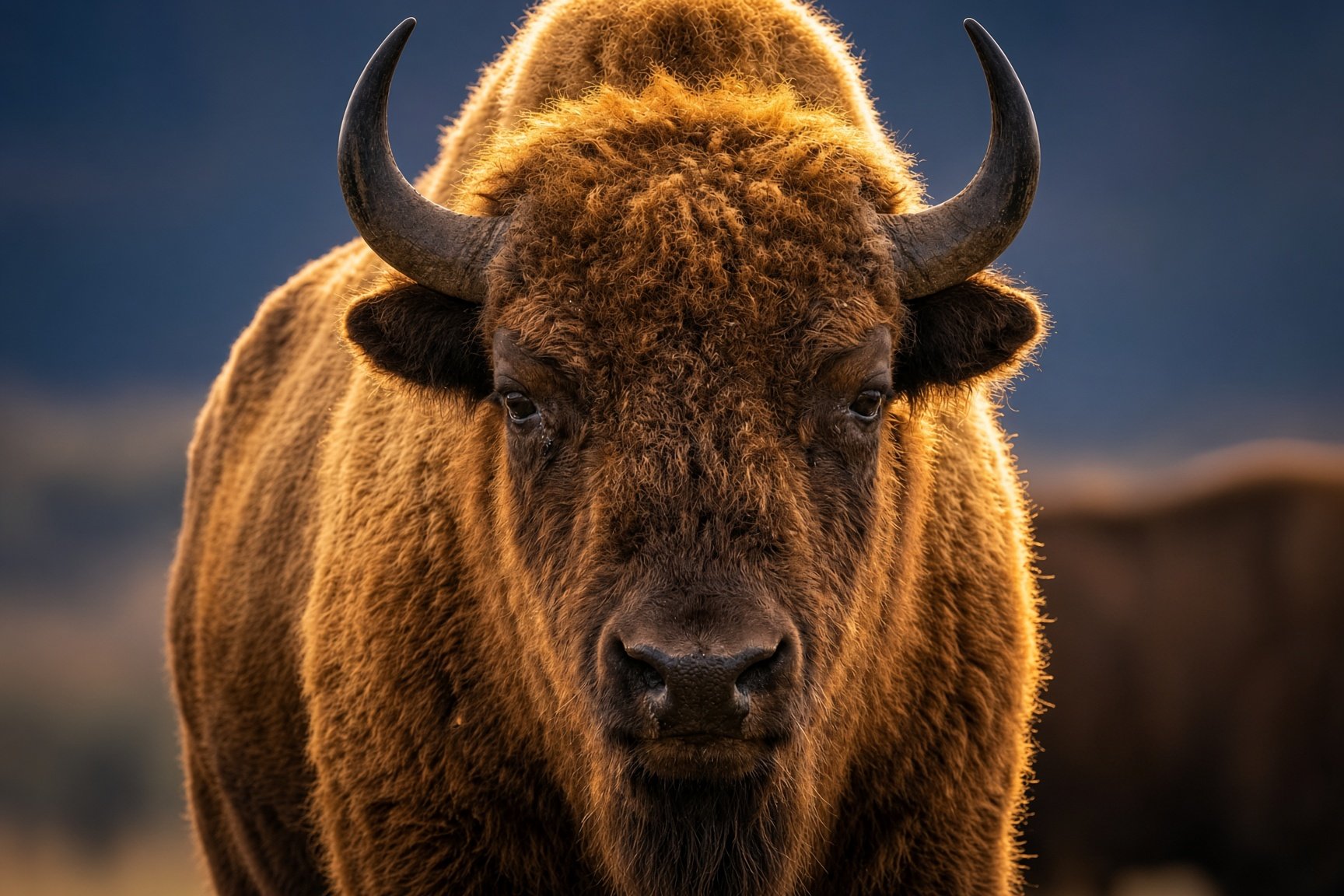
The American bison is an impressive animal. It has two horns. Its thick coat, gentle-looking face, and seemingly unhurried disposition can make it appear approachable. Tourists visiting Yellowstone National Park often find themselves captivated by these magnificent creatures. Some are tempted to get close, perhaps even imagining that the animal is nothing more than an oversized, fluffy cow.
But appearances can be deceiving.
The signs throughout Yellowstone offer a rather memorable warning:
“Don't pet the fluffy cows.”
There is a reason for that warning. A bison is a powerful, unpredictable wild animal. Its appearance does not change its nature, and getting too close can have serious consequences.
Spiritual Lesson
Not everything that looks harmless is safe. Not everything that sounds Christian is biblical. Not everything presented in the name of morality represents the character of Christ. Political promises that appeal to our values do not necessarily lead us in the direction Scripture has outlined.
The lamb-like beast is particularly sobering because it initially looks so appealing. You want to pet it, and get involved with it. Yet Scripture tells us to examine its eventual actions rather than be persuaded by its appearance.
The elephant or the donkey may occupy the current temporal seat of power, but neither determines the final destination of God's people. Voting for a party is like deciding if you prefer the Devil in red or blue. The prophetic picture remains unchanged, regardless of which political personalities capture the nation's attention.
Our responsibility is to become more firmly anchored in Jesus Christ, more thoroughly acquainted with Scripture, and more faithful to the commandments of God while sharing the Good News and Three Angels' Messages.
One day, the issues that presently divide our political landscape will give way to a much greater question: Whom will we worship, and whose authority will we recognize?
When that day comes, campaign promises will mean very little. Political alliances will offer no refuge. Popular opinion will not determine what is right. Only those whose faith is firmly established in Christ will have the spiritual foundation necessary to stand.
Until then, keep your eyes on Jesus, your hands on the Gospel plow, and your heart surrendered to the authority of God.
And whatever happens during the next term, remember the signs in Yellowstone National Park:
“Don't pet the fluffy cow.”
****
Michael Jon Cookenmaster is an educator, educational leader, consultant, and musician whose career has spanned more than three decades in Adventist and public sectors. He has been married to his wife, Marcie for 35 years, and they are proud parents of five amazing adults, and grandparents.
