

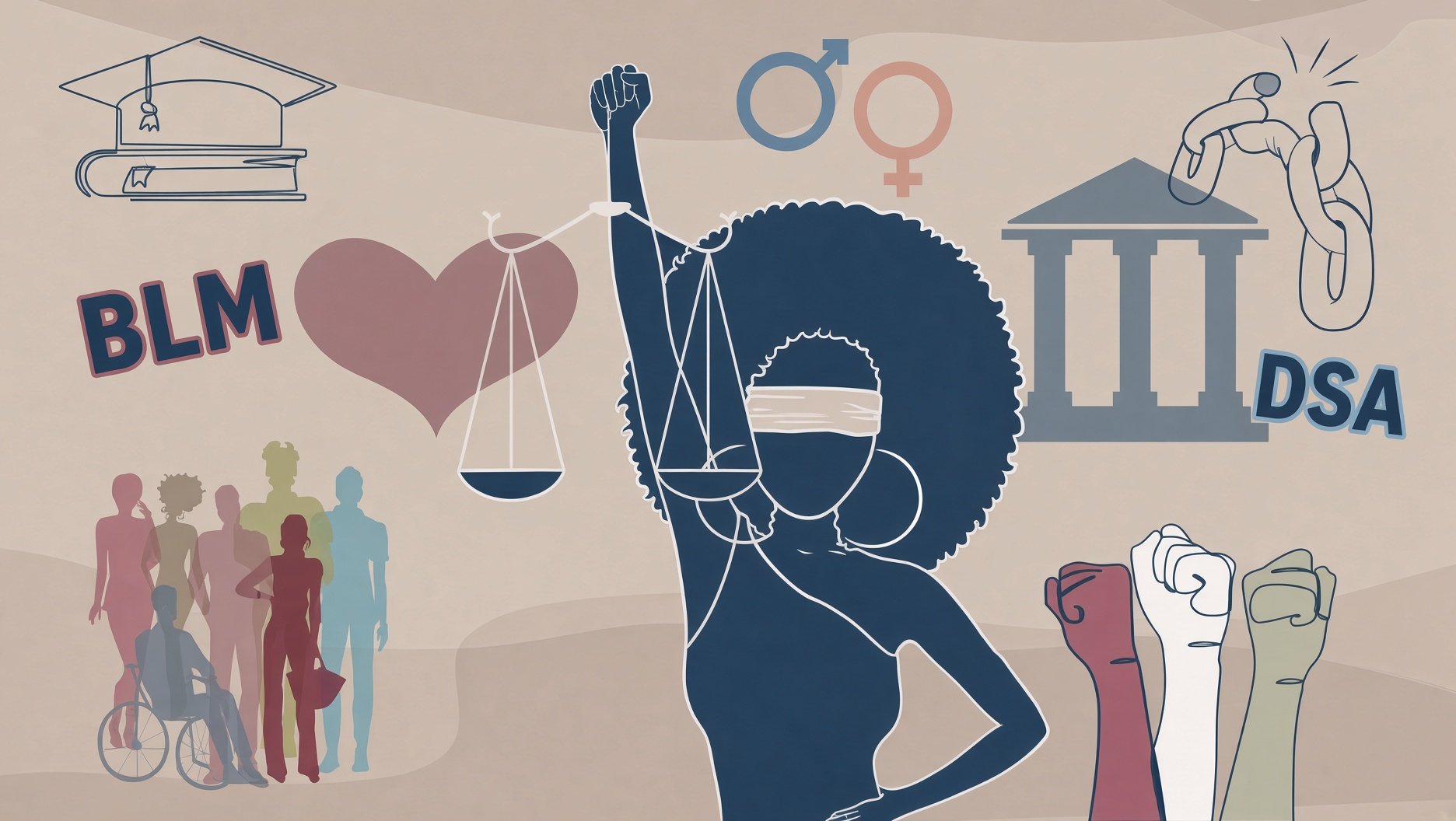
Throughout this series we have discovered that the gospel unites while social justice divides, that the gospel forgives while social justice keeps score, and that the gospel gives righteousness by faith while social justice assigns it by identity and works. Before we turn to our fourth contrast, some readers may be asking what evidence there is that social justice is rising as an ideology within the Adventist Church.
The Rise of Social Justice
Since 2020, many Adventists have noticed social justice language and themes being voiced increasingly in our pulpits, universities, church publications, ministries, podcasts, and youth resources. Sometimes these are presented openly, and at other times they come wrapped in language that sounds Christian but carries an undercurrent of selective empathy foreign to biblical justice (John 3:16; Leviticus 19:15; Romans 2:11).
This social justice trend is not imaginary. In 2020, church statements at the highest levels adopted social justice language, and that year alone, church entities across North America issued some two dozen official statements on race and racial justice, while a church-sponsored conference on racial justice for pastors and leaders drew hundreds of participants.
In 2021, one of our universities hosted a "Congress on Social Justice." By 2024, a conference was holding workshops on "Adventism's roots in social justice" and how to move the local church to get involved. Since then, the trend has only grown. Books and articles by Adventist authors now commend social justice to our members, podcasts and online platforms promote its vocabulary, and conventions have featured it prominently.
In June 2026, one of our own universities held its sixth annual "lavender graduation" on the grounds of its university church, honoring LGBTQ graduates, and for the first time senior administrators took part. In doing so, the university lent its voice to the affirmation of lifestyles that Scripture describes as sin (1 Corinthians 6:9-11). This should surprise no one, since organizations that embrace social justice tend to embrace these movements as well, counting them among the "oppressed."
Some church entities have even written diversity, equity, and inclusion into their mission or strategic statements, and at least one church event held just days before a major election gave a platform to a candidate who openly identifies as a democratic socialist, a political philosophy that draws heavily on Marxist thought. Readers of this series will not be surprised that those who embrace social justice would welcome such a candidate.
The Odd Couple
The real irony is that social justice advocates pursue political power to enforce their own ideology and then condemn "Christian nationalism" for doing the same. By "Christian nationalism," I mean what many Adventists mean by it: the effort to use the power of the State to enforce Christian beliefs. In this sense, social justice and Christian nationalism have two things in common: both seek to control the power of the State through political means, and both claim to be Christian. The truth is that social justice and Christian nationalism are an odd couple who hate each other in public but hold hands in the dark, as we will see in Part 6.
To Be Fair
Some of these social justice gatherings addressed real evils, such as sex trafficking and domestic abuse. Christians should wholeheartedly oppose these. But listen long enough, and you will discover, as we have shown throughout this series, that the real villains in the social justice narrative are white, heterosexual, Christian men, and anyone else who dares to reject their Marxist worldview.
Exhibit A: Charlie Kirk
Nothing exposed this double standard more clearly than the contrast between how our church responded to two deaths. After George Floyd died under the knee of a Minneapolis police officer in May 2020, leaders at the highest level of our church sent letters of condolence to his family on behalf of the worldwide church, along with a fruit arrangement. Church leaders on several continents issued statements condemning racism and violence, and in Minneapolis more than 350 volunteers from 16 Adventist churches and three conferences marched to the Floyd memorial, kept 8 minutes and 46 seconds of silence, and laid flowers in his memory.
Yet when Charlie Kirk, a young Christian husband and father of two, was assassinated on a college campus in September 2025, those same highest levels of church leadership, so far as this writer can find, said nothing publicly. A few courageous ministries spoke up, and several conferences did issue statements, chiefly to rebuke those ministries for embracing figures with "Christian nationalistic, racist, xenophobic, sexist" ideologies.
Such a contrast reveals more than a double standard; it reveals a lack of courage to stand up for a young Christian who was assassinated and, some would say, martyred. Even if the above charges against Kirk's views were true, and this writer believes they are not, George Floyd's long criminal record and history of drug addiction rightly did not keep the church from mourning him, and neither should Kirk's opinions have kept us silent. Scripture never makes our sorrow over a murdered man depend on whether we approve of his politics, for we are to "weep with them that weep" (Romans 12:15), and Christ commands us to love even our enemies (Matthew 5:44). Empathy that flows in only one direction falls short of biblical compassion and exposes the selective empathy of social justice.
Kirk fit the very profile that social justice casts as the villain, and it will forever be a blight on the history of this church that its highest leaders said nothing on behalf of this young man. Such is the intimidating power of this false gospel called social justice. Rather than healing society, it wounds it, and rather than casting out the demons of violence, hatred, bigotry, and discrimination, it invites back "seven other spirits more wicked than himself," so that "the last state of that man is worse than the first" (Matthew 12:45).
Before You Say "Amen"
When we borrow the world's labels, eventually, we end up borrowing its toxic ideas too. Social justice, like a Trojan horse, has entered our church with little resistance. In fact, like the citizens of Troy, many applaud it. Who would be against justice, diversity, equity, inclusion, and antiracism? These are beautiful terms that every compassionate person should accept, right? But what most don't understand is that social justice uses a different dictionary. So, before you say "amen" when a social justice advocate speaks from your pulpit or lectern, make sure you clearly understand what he or she means by the following words.
Justice: Redistributive justice. Taking from the "oppressors" and giving to the "oppressed" through State policies and taxes that advantage minorities and disadvantage majorities.
Equity: Equality of outcome rather than equality of opportunity. Everyone gets "free" access to healthcare, education, and housing even if they have not earned it.
Inclusion: Inviting all to sit around the table while requiring some to give up their seats.
Antiracism: The "oppressor" must keep "doing the work," and in Ibram X. Kendi's words, "The only remedy to past discrimination is present discrimination" (How to Be an Antiracist, 2019, p. 19).
Diversity: Counting heads by color. Too often it simply means "less white."
Diversity Is Not Our Strength
I am no prophet, neither a prophet's son (Amos 7:14), but if we continue promoting DEI, openly or subtly, throughout our institutions, then those whom social justice casts as "oppressors" will soon find themselves marginalized within their church. How can this be in a church raised up to carry the everlasting gospel "to every nation, and kindred, and tongue, and people" (Revelation 14:6)? God sent us with the everlasting gospel to reach diverse people groups, but He never called us to diversify them.
The Seventh-day Adventist Church became the most racially diverse religious group in America (Pew Research Center, 2015) because we focused on taking the three angels' messages to the world, and diversity followed as the result. Our strength lies in our unity under the banner of Jesus Christ and our shared mission to proclaim the everlasting gospel.
For this reason, no region of North America should be viewed as needing to be diversified simply because it is largely white, and no congregation should be treated as a problem to be fixed because most of its members are white. Every congregation, whatever its color, deserves a pastor who loves its people and longs to see it grow.
Because white Americans are still the majority in the United States, many in the church see no cause for concern here. Yet Census Bureau projections show white Americans becoming a minority in this country around 2045, and those of European descent are already a minority worldwide. A church that follows the apostles' example in Acts 6, where they made sure no widow was overlooked whatever her background, will care for the health of every people group in its fellowship.
Anyone who raises these concerns can expect to be met with labels such as "white fragility," "centering whiteness," "internalized whiteness," or "white grievance." Labels of this kind are meant to end a conversation before it begins, yet our church needs these conversations, and it needs them soon.
If We Stay Together
Many will remember the scene in the movie Gladiator (2000) in which Maximus, a Roman general turned slave, rallies his fellow gladiators as they are sent into the arena to reenact the fall of Carthage. "If we stay together, we survive," he tells them, and when the war chariots charge, the gladiators lock their shields together and stop them in their tracks. Paul calls the church to the same stand, urging believers to "stand fast in one spirit, with one mind striving together for the faith of the gospel" (Philippians 1:27).
Pursuing diversity may appear to strengthen us, yet in the end it leaves us weaker. Our true strength lies in holding the line together under the banner of Jesus, united in one mission to carry the everlasting gospel to every people group. By God's grace, that unity will hold His church together and stop the devil in his tracks in these last days.
Admit the Light
Despite the rise of social justice within Adventism, there is good news! Ellen White put it like this: "The way to dispel darkness is to admit light" (The Desire of Ages, p. 498). The best weapon we can use to drive social justice ideology out of our schools, churches, and conferences is the pure gospel itself, a gospel so powerful that it can change the heart of any man, woman, or child who submits to the molding influence of the Holy Spirit. As Ellen White declared, "For earth's sin and misery the gospel is the only antidote" (The Ministry of Healing, p. 141).
The Bible tells us that when we receive the true gospel of Jesus, which is by grace through faith and not of works, we become living furniture in the carpentry shop of Jesus, for "we are his workmanship, created in Christ Jesus unto good works" (Ephesians 2:10).
4. The Gospel Goes to the Root: Social Justice Cuts at the Weeds
Christ Will Stick Out
A little boy once heard his pastor preach that Jesus wants to live in our hearts. After the service, he walked up to the pastor and asked, "Pastor, if I'm so small and Jesus is so big, won't He stick out if He lives inside me?" The pastor smiled and replied, "Yes, He certainly will."
That little boy understood something many adults miss. When Jesus truly lives within us, people should see the difference. The Bible says that God "is able to do exceeding abundantly above all that we ask or think, according to the power that worketh in us" (Ephesians 3:20). Our world needs to hear that message again, and our churches need to preach it.
Jesus died on Calvary to forgive our sins, yet His work did not end there. He rose again, ascended to heaven, and now ministers as our great High Priest in the heavenly sanctuary. Through His intercession, He pardons repentant sinners and provides grace and power to overcome temptation and live victorious Christian lives (Hebrews 4:14-16; 7:25; 8:1-2).
Isn't that good news? Before His birth, the angel declared, "thou shalt call his name JESUS: for he shall save his people from their sins" (Matthew 1:21). Too often the church emphasizes forgiveness while saying too little about victory, overcoming, and Christ's sanctifying work through the Holy Spirit (Romans 8:4). When the power of the gospel is at work in a believer's life, it also shows itself in willing and impartial acts of kindness. In Part 5 we will see how that impartial love crosses every line of race and class, from the wounded stranger on the road to Jericho to the wealthy tax collector in the sycamore tree.
A Johnny-Come-Lately
Such gospel-driven kindness has flourished for two thousand years, long before the term "social justice" was coined in the 1840s. In fact, social justice is something of a Johnny-come-lately.
Seminary professor Philip G. Samaan, drawing on Ellen White, has shown that Jesus followed a clear pattern in reaching people: He socialized with them, sympathized with them, served them, and then shared the gospel with them. These steps can guide gospel workers in every generation and culture, for as Ellen White wrote, "Christ's method alone will give true success in reaching the people. The Saviour mingled with men as one who desired their good. He showed His sympathy for them, ministered to their needs, and won their confidence. Then He bade them, 'Follow Me'" (The Ministry of Healing, p. 143).
From its earliest days, the Adventist Church has put this method into practice, opening hospitals and schools, feeding the hungry through community services, and responding to disasters around the world. This is how the church has always met real human need: with practical compassion that flows from changed hearts and points people to Christ. It has never needed the help of unbiblical and unchristian ideologies such as social justice, and it never will.
When the Heart Is Left Unchanged
When the transforming power of the gospel is neglected, people naturally begin searching elsewhere for answers to society's brokenness. They turn to the government or begin blaming others, and in that atmosphere social justice is easily embraced. Yet social justice offers no solution other than dismantling the systems, institutions, governments, and power structures it labels systemically evil. But systems are only as good as the people who build and govern them. Throughout history, Communist revolutions that promised to create a just society have always replaced one form of oppression with another, often much worse, because the human heart remained unchanged. Only Jesus, through the true gospel, can change the heart, which is why David prayed, "Create in me a clean heart, O God; and renew a right spirit within me" (Psalm 51:10).
But as our hearts are changed by the new covenant work of Jesus in the heavenly sanctuary, our hands will reach out to minister to the needs of others while we share the saving, life-transforming power of the gospel. Society changes as individual Christians allow Jesus to serve through them, generously and sacrificially, and as they speak the words of life, for the gospel cannot be preached without words (Romans 10:14).
The everlasting gospel transforms the heart, resulting in obedience to God's law of love (Titus 2:11-14; Romans 8:4). Through the Holy Spirit, Christ writes His law on our hearts and empowers His people to walk in His ways (Hebrews 8:10; Ezekiel 36:26-27). As Ellen White writes, "The righteousness of Christ is not a cloak to cover unconfessed and unforsaken sin; it is a principle of life that transforms the character and controls the conduct" (The Desire of Ages, p. 556).
Sin Oppresses
Christians understand that every sin ultimately offends God and oppresses our fellow human beings. Whether we lie, steal, murder, commit adultery, covet, dishonor our parents, profane God's name, break the Sabbath, or violate any other of God's commandments, we wound relationships and violate God's law of love.
In Romans 3, after declaring that "all have sinned, and come short of the glory of God," Paul describes how sin expresses itself in cruelty, deceit, violence, and injustice toward others (Romans 3:10-18, 23). The Bible's diagnosis is clear: since all have sinned and all have been sinned against, all have been oppressors, and all have been oppressed. Therefore, we all need forgiveness, mercy, and a converted heart.
Weeds and Roots
Social justice offers a superficial approach. Rather than beginning with the sinful human heart, it focuses on structures, systems, and power dynamics. This is as futile as cutting down a weed while leaving its roots untouched.
In this, social justice resembles the Pharisees, who made "clean the outside of the cup and of the platter" while within they were "full of extortion and excess" (Matthew 23:25). What society needs most is better people, transformed by the gospel of Jesus, which works from the inside out. As Jesus told the Pharisees, "cleanse first that which is within the cup and platter, that the outside of them may be clean also" (Matthew 23:26).
Jesus did not say, "Out of unjust systems proceed evil thoughts, adulteries, fornications, murders, thefts, covetousness, and wickedness." He said these things proceed from the human heart (Mark 7:21-23). Because social justice does not recognize that oppression flows from the fallen heart of every human being, it seeks solutions primarily through social restructuring rather than spiritual transformation (Jeremiah 17:9).
The gospel addresses the root cause. The biblical answer to suffering and oppression begins with transforming sinners, and changed systems follow. When hearts change, relationships change, and communities soon follow. The gospel renews society by first creating a new heart within us.
As men and women see their sinful condition, repent, and surrender to Christ, the Holy Spirit imparts Christ's righteousness and produces the fruit of the Spirit within them. Only Christ living in the heart can enable us to walk in God's law of love and treat God and our neighbors justly. This is why the prophet Micah wrote, "He hath shewed thee, O man, what is good; and what doth the LORD require of thee, but to do justly, and to love mercy, and to walk humbly with thy God?" (Micah 6:8). Notice that it is God who shows us what justice is, and no finite source can take His place.
In Part 5 we will see how the gospel produces impartial love while social justice plays favorites, and in Part 6, the final article in this series, we will see how the gospel advances God's kingdom while social justice advances the political aspirations of this world.
****
Gary Blanchard is the president of the Northern New England Conference.
