

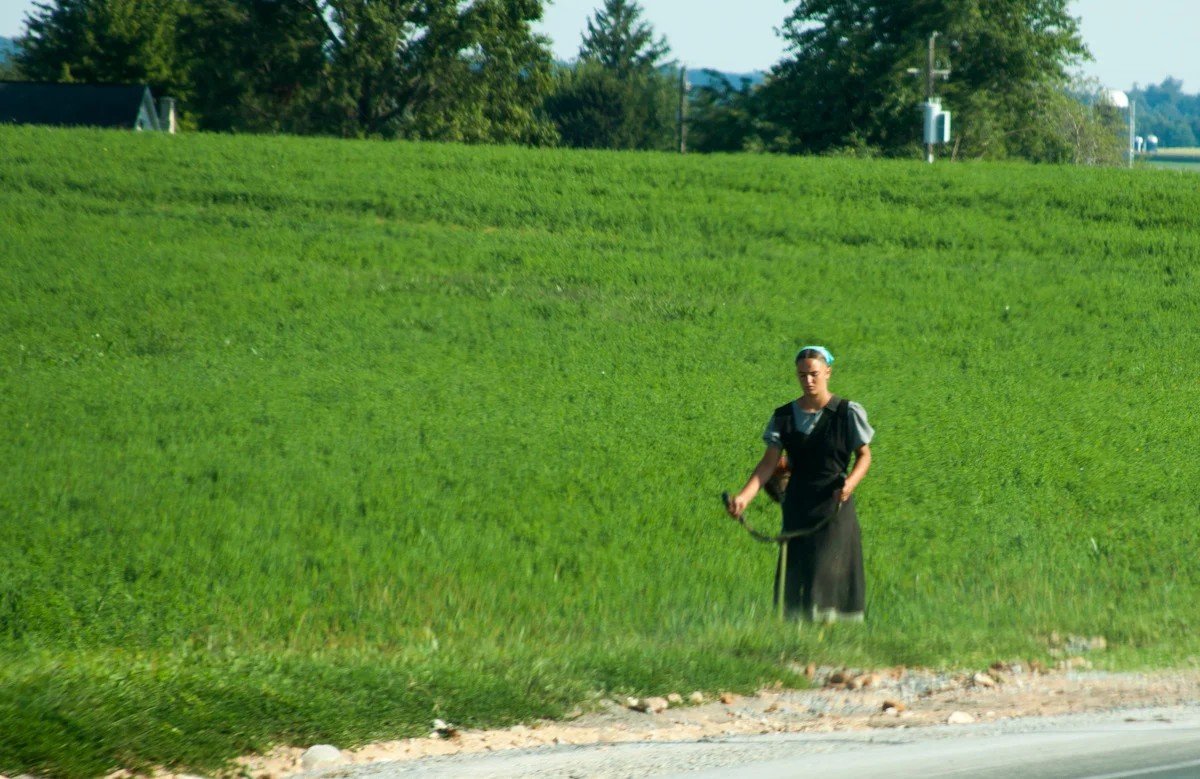
In the quiet fields of Lancaster County, Pennsylvania, a 23-year-old Amish woman was simply tending her yard on October 14 when an illegal immigrant from Guatemala stepped up behind her with a long serrated knife and a pair of handcuffs. Junior Jose Davila-Moran, 26, demanded she submit so he could restrain her. He told her everything would be all right if she cooperated.
She did not. She screamed, revved the motor of her weed whacker, and took a step toward him. He turned and ran, vanishing behind a barn. She later identified his photograph in a lineup and said it made her tremble. Police tracked him through a neighbor’s trail cam footage. He was arrested two days later in New Jersey on charges that include kidnapping, false imprisonment, terroristic threats, and related offenses. ICE placed a detainer on him.
Davila-Moran is a Guatemalan national who entered the United States illegally. Border Patrol arrested him in Texas in January 2018 when he was still a juvenile. He was handed to the Office of Refugee Resettlement and released into the country. Eight years later he allegedly drove from New Jersey into Amish country carrying a knife and handcuffs.
This is not an isolated failure of paperwork. It is the predictable result of years of policies that treat illegal entry as a minor inconvenience and release rather than remove those who cross unlawfully. Communities that deliberately live apart from the world’s noise—communities that work with their hands, keep to themselves, and rely on the ordinary protection of the law—are left exposed. The same voices that for years insisted open borders were compassionate now confront the reality that compassion without borders is not compassion at all. It is the transfer of risk onto people who asked for nothing more than to finish their work in peace.
Romans 13 reminds us that governing authorities exist to restrain evil. When those authorities decline the task, private citizens are forced to improvise with garden tools. That is not the order of a free society. It is the disorder that follows when lawlessness is preferred to the plain duty of enforcement. The Amish woman did what she had to do.
The larger question is why she was put in the position of having to do it at all.
****
“For rulers are not a cause of fear for good behavior, but for evil. Do you want to have no fear of authority? Do what is good and you will have praise from the same; for it is a minister of God to you for good. But if you do what is evil, be afraid; for it does not bear the sword for nothing; for it is a minister of God, an avenger who brings wrath on the one who practices evil. Therefore, it is necessary to be in subjection, not only because of wrath, but also for conscience’ sake” (Romans 13:3-5).
