

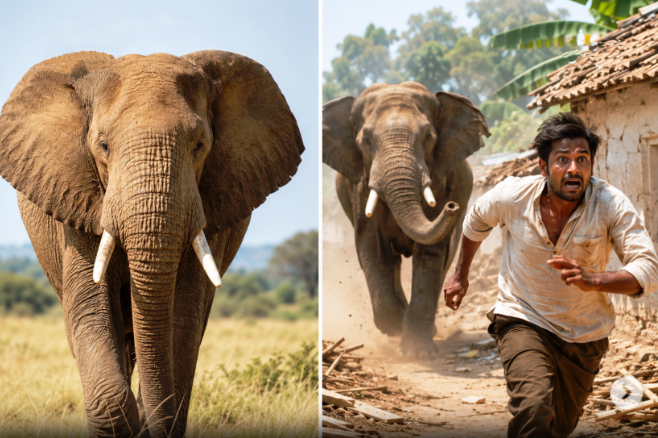
Sin is not a passive flaw in our universe, but an active, indwelling force—wild, relentless, and bent on death. It stalks us, breaks into our homes, and tramples what we hold dear. Few modern illustrations capture this better than Dhurbe, the notorious wild bull elephant of Chitwan National Park in Nepal.
For over 16 years, Dhurbe the elephant has terrorized villages on the park’s fringes. He has killed approximately 25 people and destroyed more than 50 homes.
In 2012, Dhurbe killed Budhiram and Jharali Bote near Nepal’s Chitwan National Park. Terrified, the surviving family sold their belongings and relocated 17 kilometres away, crossing two rivers in the hope of avoiding future attacks. On July 4, 2026, this same elephant reached their new home, broke through the mud walls, and killed the family’s 25-year-old daughter-in-law and four-year-old grandson. Somehow he tracked them down 14 years later and 11 miles away.
No distance, no relocation, no human effort fully escapes him. He raids at night, driven by an inner compulsion that defies logic. Collars, warnings, even army intervention have failed to contain him fully. He remains a force of sudden, crushing violence.
Romans 7
In Romans 7, the Apostle Paul lays bare the human condition with raw honesty: “I do not understand what I do. For what I want to do I do not do, but what I hate I do… It is sin living in me that does it” (Romans 7:15-17, NIV).
Paul’s insight resonates with each of us. Like the “law of sin” at work in our members (Romans 7:23), Dhurbe embodies an evil that operates beyond rational control or environmental excuses. He does not negotiate with human boundaries. He does not respect attempts at coexistence. He seeks to devour.
The elephant’s persistence mirrors how sin follows us into new seasons of life, new “homes” of supposed safety—whether relationships, habits, or attempts at self-reform—only to reappear and destroy. We move, we build fences, we try to kill it, we try to outrun it, yet the old nature finds us.
Just as villagers live in fear of the rogue bull, humanity groans under sin’s tyranny. Paul cried out, “Who will rescue me from this body that is subject to death?” (Romans 7:24).
The answer, of course, is Jesus Christ, who breaks the power of indwelling sin through His death and resurrection (Romans 7:25; 8:1-2).
Dhurbe reminds us that evil is no abstract idea. It is a wild thing that seeks to kill, steal, and destroy (John 10:10). Only the delivering grace of God can free us from being trampled under its massive angry feet.
In a world quick to offer naturalistic explanations for sin, the biblical truth cuts through to the heart: sin is real, personal in its effects, and deadly—until grace intervenes.
****
