

Were Daniel and his three friends disobeying God when they refused to bow to the golden image, and when Daniel refused to stop praying to anyone but the king for thirty days?
Years earlier, the prophet Jeremiah had spoken to the children of Israel. He told them the Babylonians were coming and that, rather than resisting, they should “put their necks under his yoke.” In other words, they were to submit to Babylonian rule. This was not merely Jeremiah’s opinion. As a true prophet, he delivered a directive that came from God Himself:
“If, however, any nation or kingdom will not serve Nebuchadnezzar king of Babylon or bow its neck under his yoke, I will punish that nation with the sword, famine and plague, declares the Lord, until I destroy it by his hand. … But if any nation will bow its neck under the yoke of the king of Babylon and serve him, I will let that nation remain in its own land to till it and to live there, declares the Lord” (Jeremiah 27:8, 11, NIV)
Jeremiah repeated the same message to King Zedekiah: “Bow your neck under the yoke of the king of Babylon; serve him and his people, and you will live” (Jeremiah 27:12).
So why, then, did Daniel’s three friends (Shadrach, Meshach, and Abednego) refuse the king’s command in Daniel 3, and why did Daniel himself refuse the king’s decree in Daniel 6? On the surface they appear insubordinate to the very authority God had told His people to accept. They would not bow to the golden image when commanded, and Daniel would not stop praying to God when ordered to petition only the king for thirty days.
Their response in the furnace episode is clear:
“King Nebuchadnezzar, we do not need to defend ourselves before you in this matter. If we are thrown into the blazing furnace, the God we serve is able to deliver us from it, and he will deliver us from Your Majesty’s hand. But even if he does not, we want you to know, Your Majesty, that we will not serve your gods or worship the image of gold you have set up.” (Daniel 3:16-18, NIV)
Daniel, knowing the decree had been signed, continued his lifelong practice of praying three times a day with his windows open toward Jerusalem (Daniel 6:10).
So why were they insubordinate?
If you can answer that question, you will better understand what makes the United States of America exceptional. The framers of the Constitution and Declaration of Independence understood the same inalienable reason.
The answer is found in Romans 13. Paul teaches that governing authorities are established by God and have a God-given responsibility to punish wrongdoers and commend those who do right. He writes:
“Let everyone be subject to the governing authorities, for there is no authority except that which God has established. The authorities that exist have been established by God. … For the one in authority is God’s servant for your good. But if you do wrong, be afraid, for rulers do not bear the sword for no reason. They are God’s servants, agents of wrath to bring punishment on the wrongdoer. … This is also why you pay taxes, for the authorities are God’s servants, who give their full time to governing.” (Romans 13:1, 4, 6, NIV)
Paul then quotes from the Ten Commandments, but only those laws that govern relationships between people: “You shall not commit adultery,” “You shall not murder,” “You shall not steal,” “You shall not covet,” summing them up in the command to “Love your neighbor as yourself” (Romans 13:9). He deliberately leaves out the first four commandments, which concern our direct relationship with God (no other gods, no idols, not taking the Lord’s name in vain, and remembering the Sabbath).
This is intentional. The civil government is ordained by God to protect people from one another. Every human being possesses the rights to life, liberty, and the pursuit of happiness, not as gifts or favors of the state, but as natural rights belonging to beings made in the image of God (Genesis 1:27). The Declaration of Independence states it plainly:
“We hold these truths to be self-evident, that all men are created equal, that they are endowed by their Creator with certain unalienable Rights, that among these are Life, Liberty and the pursuit of Happiness.”
The government’s jurisdiction should have nothing to do with the first four Commandments, except to protect the individual’s right to “worship him who made heaven and earth, the seas, and the fountains of water” (Revelation 14:7).
The government must restrain people from harming one another, but it has no rightful authority over a person’s relationship with God. It cannot compel worship on Sunday or Saturday, or dictate the content of prayer and conscience.
Governing the conscience is not the responsibility of the state or the Church for that matter. It is an individual right and privilege. It is personal freedom with accountability to God alone,
“Rejoice, O young man, in your youth, and let your heart cheer you in the days of your youth. Walk in the ways of your heart and the sight of your eyes. But know that for all these things God will bring you into judgment” (Ecclesiastes 11:9).
This is precisely why Daniel and his three friends could not and would not obey the civil commands of their day. The Babylonian and Medo-Persian governments had overreached. They were no longer merely protecting man’s horizontal relationships; they were demanding the worship that belongs to God alone.
In the same spirit, Peter and John later stood before the Sanhedrin and declared: “We must obey God rather than human beings!” (Acts 5:29, NIV).
As Christians we are called to faithful citizenship under just laws. We pay taxes, respect lawful authority, and thank God for governments that use the sword to restrain evil and protect the innocent.
When we speak of “just laws,” Martin Luther King Jr. gives a clear biblical distinction in his Letter from Birmingham Jail:
“A just law is a man-made code that squares with the moral law or the law of God. An unjust law is a code that is out of harmony with the moral law. To put it in the terms of St. Thomas Aquinas: An unjust law is a human law that is not rooted in eternal law and natural law. Any law that uplifts human personality is just. Any law that degrades human personality is unjust.”
Just laws are those that harmonize with the moral law, God’s law of love. Unjust laws that invade the realm of conscience and worship must be resisted, even at great cost, while still showing respect for the legitimate role of government.
Unlike Babylon, the United States was founded with a clear understanding of this boundary between civil responsibility and religious liberty. It is this understanding that has made us a great nation!
The First Amendment protects the free exercise of religion and forbids the establishment of religion by the state. Both Thomas Jefferson, the primary architect of the Declaration of Independence, and James Madison, the principal author of the Constitution, understood that there must be a wall of separation between civil and religious authority.
Jefferson wrote to the Danbury Baptist Association on January 1, 1802:
“Believing with you that religion is a matter which lies solely between Man & his God, that he owes account to none other for his faith or his worship, that the legitimate powers of government reach actions only, & not opinions, I contemplate with sovereign reverence that act of the whole American people which declared that their legislature should ‘make no law respecting an establishment of religion, or prohibiting the free exercise thereof,’ thus building a wall of separation between Church & State.”
Madison expressed the same conviction when he wrote:
“Every new & successful example therefore of a perfect separation between ecclesiastical and civil matters, is of importance. And I have no doubt that every new example, will succeed, as every past one has done, in shewing that religion & Gov will both exist in greater purity, the less they are mixed together” (Letter to Edward Livingston, July 10, 1822).
This clear boundary between civil and religious power is what the founders sought to protect. These two horns of power (civil and ecclesiastical) make up the lamb-like beast of Revelation chapter 13.
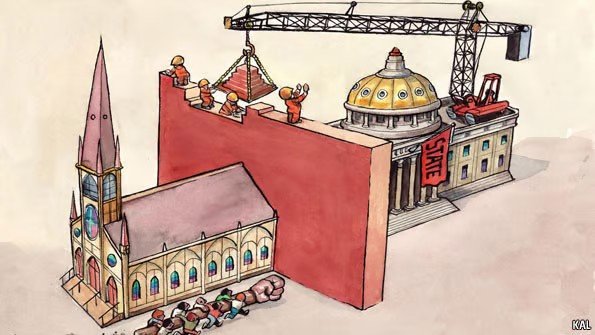
Sadly, however, Revelation 13 warns of a coming change in which that boundary will be erased and one’s relationship with God will no longer be treated as a private and inalienable right in the United States.
It makes me almost sick to write it.
One day, the wall of protection for religious liberty will come down, and civil and ecclesiastical powers in this dear country will be used to compel worship. America will one day “repudiate” its ideals regarding religious liberty.
When that day arrives, may we not be taken by surprise, but like Daniel and his three friends, may we choose to obey God rather than man.
And may we never forget that the same Jesus who walked with those three young men in the fiery furnace (Daniel 3:25), and with Daniel in the lions’ den, has promised to walk with us in the coming crisis.
“And surely I am with you always, to the very end of the age.” (Matthew 28:20, NIV)
And again:
“Never will I leave you; never will I forsake you.” (Hebrews 13:5, NIV)
That is the sure hope of every believer who, when conscience and command collide, refuse to bow.
****

Gary Blanchard is President of the Northern New England Conference of Seventh-day Adventists.
