

This article was posted on Ron Meinhardt's Substack two days ago. It offers a warning about new 2025 GC Rules of Order which take away power from the delegates and give it to the person chairing the session. We don’t know if Ron Meinhardt is a delegate, we are working to find out. He appears to be a credible individual, he was a Director at Uchee Pines and has several presentations on Audioverse. His article is offered without endorsement or commentary from Fuclrum7 staff.
Warning to 2025 SDA General Conference Delegates: The Rules of Order are Stacked Against You!
But here's what you can do about it...
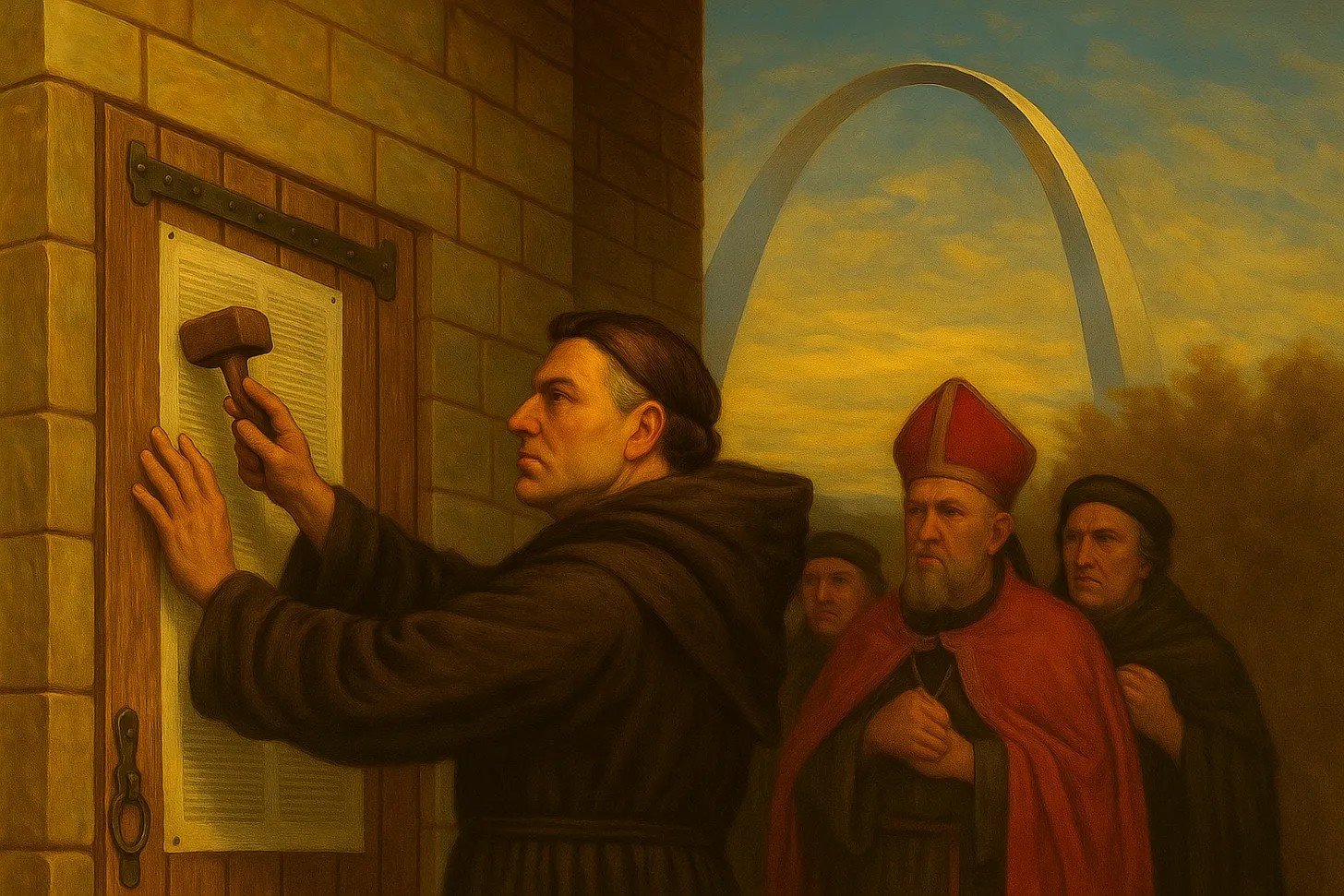
It has been recently discovered that several of the 2025 GC Session "Rules of Order," and a number of the previous rules, may give disproportionate control to the Session Chair and Secretariat—potentially making it difficult for delegates to raise new issues, challenge procedural injustice, or propose reform.
Q: WHAT HAS CHANGED REGARDING THE 2025 GC RULES OF ORDER?
A: NEWLY IMPLEMENTED RULES FOR THE 2025 SPRING SESSION:
• Article 3 section D was amended to give the Chair full authority to decide whether a delegate’s motion to amend is appropriate, or “clearly and precisely worded.” The Chair may decide to the cut the delegate off and rule them out of order.
• The Chair is allowed to require that any amendment be submitted in writing, adding procedural difficulty for floor motions (virtually eliminates spontaneous motions). These motions to amend can be referred, by the chair, to a committee- thus limiting opportunity for floor debate.
• However, here is arguably the worst provision voted in during the 2025 Spring Executive Committee… Article 2, Section C states the following: “If the chair believes that delegates are raising frivolous questions of privilege or points of order for an improper purpose (to be recognized ahead of other delegates, to delay, or to obstruct the work of the body), the chair may, after having given warning to the body, decline to recognize speakers who rise to raise a question of privilege or point of order.”
On page 8 the Chair is also given the prerogative to deem “frivolous, irrelevant, unnecessarily time-consuming, or obstructionist speeches or motions” out of order.
Because of the provision of Article 2, Section C, delegates who violate these arguably subjective guidelines can be ignored, presumably for the entire session if deemed appropriate. Thus, in the name of “preserving order” the Chair can silence whomsoever they choose, potentially without recourse. At this point, disenfranchised delegates may desire to remove the Chair, which requires a two-thirds vote—making it nearly impossible for delegates to override misuse of this authority. To put this in perspective, challenging the authority of this ONE MAN, could take as much delegate consent as CHANGING THE CHURCH'S BYLAWS OR FUNDAMENTAL BELIEFS!
Q: WHAT ARE PREVIOUSLY EXISTING PROBLEMATIC RULES (NOT AMENDED BUT POTENTIALLY UNFAIR)?
A: SEE BELOW:
• On page 8, under the heading “Duties of the Chair,” the following is stated: “It is the duty of the chair to hold speakers to their allotted time and help move business along as expeditiously and fairly as possible.” This could potentially allow the Chair to limit or deny speaking time at their discretion. There is no requirement for equal opportunity, balance, or transparency in how speaking time is granted or withheld.
• Article 4, Section E, requires a two-thirds vote to revisit or reconsider previous decisions (unless previously announced). This makes it extremely difficult to challenge unfair or rushed outcomes once they have been voted on.
Without challenge, these rules can silence dissent, prevent transparency, and turn the Session into a formality—not a deliberation.
That’s why delegates must come prepared to challenge, amend, and reclaim their authority. These rules are not inspired counsel, but your responsibility to represent the Church under the dictates of your conscience is a sacred responsibility. The Session belongs to the delegates—not to the administrators, not to the Chair, not to the Parliamentarian.
Q: SHOULD DELEGATES TRULY HOLD THE ULTIMATE AUTHORITY AT THE GENERAL CONFERENCE SESSION?
A: Delegates to the 2025 General Conference Session are not mere spectators. You are the supreme governing authority of the Seventh-day Adventist Church during Session (Testimonies for the Church, Vol 9, p. 260-61). All officers, committee members, and leaders ultimately must answer to you.
You have the GOD ORDAINED power to:
• Reject the GC Rules of Order (in favor of a more equitable Parlimentary style such as Robert's Rules of Order)
• Overhaul the agenda (add or subtract items)
• Replace the Chair or Parliamentarian
• Nominate alternative candidates to any elected position
• Reform the rules of order
Q: HOW THEN CAN DELEGATES PROTECT THEIR RIGHTS AND ENSURE FAIRNESS?
A: If these new GC rules are approved by the delegates, there is much less parliamentary power afforded them. Therefore, if delegates wish to ensure fair deliberative processes during the session they must NOT APPROVE the new GC Rules of Order but instead motion, second, and vote on an alternate set of Rules.
“It has been recently discovered that several of the 2025 GC Session “Rules of Order,” and a number of the previous rules, may give disproportionate control to the Session Chair and Secretariat—potentially making it difficult for delegates to raise new issues, challenge procedural injustice, or propose reform.”
For example, Robert's Rules of Order could be used, preferably with additional tweaks favoring the ultimate overruling power of the delegates over any presiding officers.
Why Robert’s Rules of Order? Even without any changes, these rules are the “gold standard” for parliamentary procedure and create an orderly and fair environment for the deliberative process.
IMPORTANT NOTE: in 2015 the agenda was voted upon before the GC Rules of Order. This year (2025) it is possible that the GC rules of Order will be voted upon first.
Q: IF WE ADOPT THE RULES BY SIMPLE MAJORITY CAN’T WE JUST DO AWAY WITH THEM LATER IF THEY PROVE HARMFUL TO THE ASSEMBLY?
A: Not so fast… Initial adoption of the rules is by simple majority. However, once adopted, it takes a super-majority (2/3) delegate vote to either change or suspend them (see page 14, 2025 GC Rules of Order).
EDIT JUNE 27th, 7:11 PM EASTERN: IMPORTANT UPDATE!!!
Just Discovered… during the last GC Session (61st) held in Saint Louis, Missouri, United States of America, from June 6 to June 11, 2022 the following AMENDMENT TO THE CHURCH CONSTITUTION was ratified (see Sec. 14).
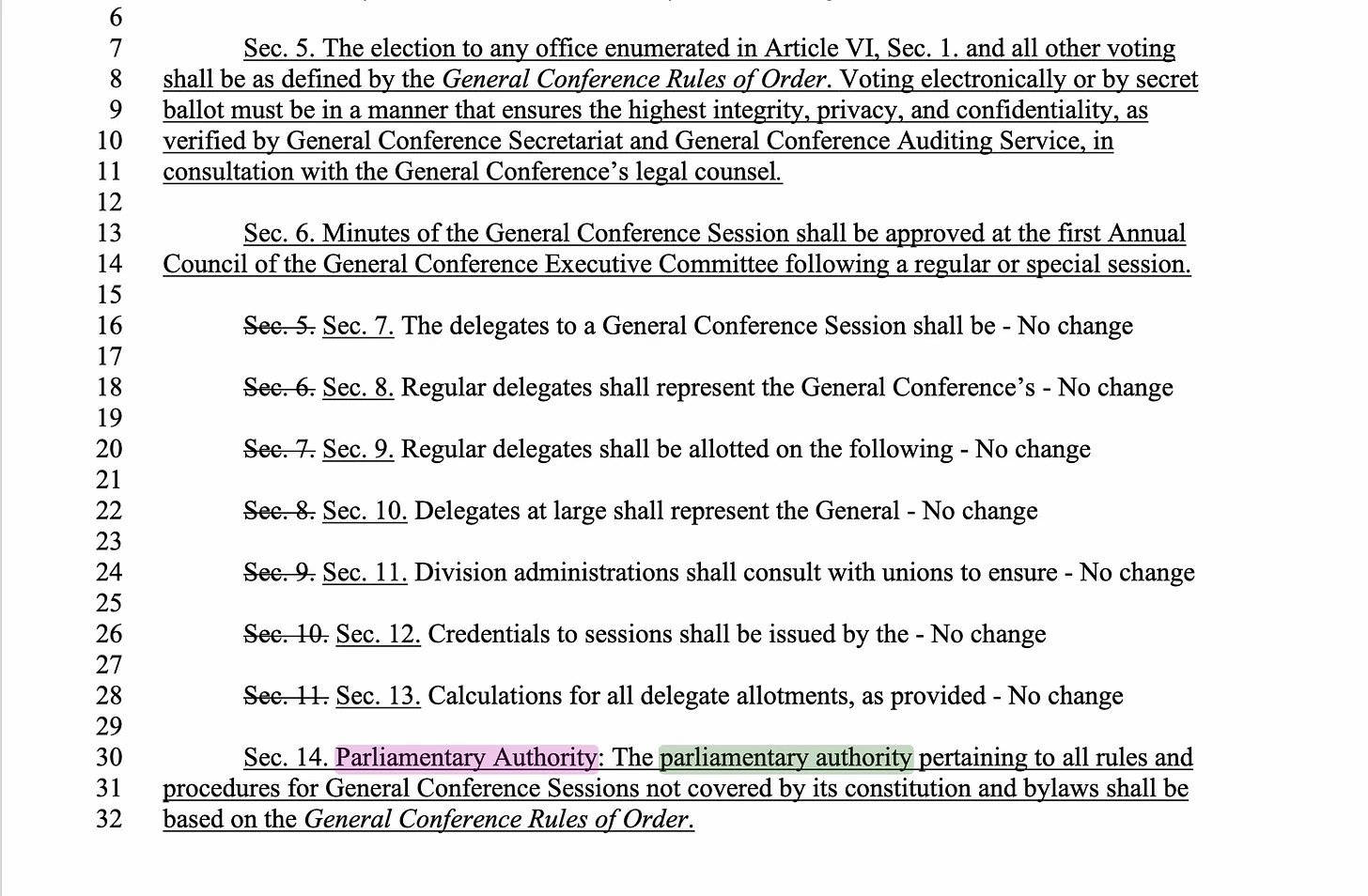
Adding Sec.14 essentially codified the GC Rules of Order into our Church Constitution. This now makes them extremely difficult suspend-and-replace, or amend without a 2/3 majority. The solution? For now the aim would be to achieve a 2/3 majority in terms of delegates opposed to the restrictive and unfair GC Rules of Order. However, though this may seem impossible, all things are possible with God! It’s time to PRAY and spread the word!
Q: ARE THERE OTHER CONCERNS REGARDING THE RULES?
A: YES! As in session past, the “ElectionBuddy” platform will be the likely methodology used to register delegate votes. Why is this a risk? Election Buddy provides the following warning for their MeetingVote option (which is used by the General Conference):"When using this setting, ensure that you or your vote administrator has no vested interest in the outcome of the vote to ensure the vote's integrity."
This warning is given because the Conference administrators, or possibly even a malicious actor not affiliated with either Election Buddy or the Conference, has your login credentials and could use them to log in to the Election Buddy platform and vote instead of you. This is categorically not ElectionBuddy's highest security mode and is not truly auditable as there is no way of verifying the legitimacy of the delegate's vote (example: if they indeed voted yea or nae).
Solution: push for transparent voting - Example: "I move that all electronic votes be auditable and results published by delegate number."
Q: WHAT IF THE NEW GC RULES ARE VOTED IN "AS IS" BY THE DELEGATES? IS THERE ANY RECOURSE THEN FOR AMENDING THE AGENDA?
A: The answer is... potentially but not as easily. At that point it really depends upon the fairness of the Chair.SPECIAL NOTE: Don’t try to use the element of surprise. Just in case the 2025 GC Rules of Order are voted in, to be in harmony with the rule governing amendments that “all motions must be submitted in writing,” file all planned initial motions (amending the agenda, calling for different voting methods, etc.) with the chair days before the meeting or at the very least before the start of the first business meeting. Make sure to obtain proof of receipt.
Q: WHAT IF WE (THE DELEGATES) WANT TO CHANGE PORTIONS OF THE AGENDA (EITHER WITH OR WITHOUT THE NEW GC RULES)?
A: MAKE A MOTION WHILE THE MOTION TO APPROVE THE AGENDA IS UNDER CONSIDERATION. HOWEVER, REMEMBER THIS SHOULD BE SUBMITTED IN WRITING TO THE CHAIR PREVIOUS TO THE FIRST BUSINESS MEETING IF UNDER THE NEW RULES (WHICH IS AN UNKNOWN AT THE START OF THE FIRST BUSINESS MEETING).
Here is the best Strategy:
1. Draft Your Motion Now - Make it specific, actionable, and clearly justified (biblically or by policy).
2. Gather Support - Obtain co-signers from multiple regions to reduce dismissal.
3. Submit and Retain Records to the Chair now (remember, just in case the GC rules get passed)- Include name and ID. Keep dated copies or photos of the submission.
4. If and when the motion is raised on the floor (by a delegate) and Rejected, Act Fast - Raise a Point of Order and follow with a Motion to Appeal the Chair's Decision. Requires a second and majority vote.
5. Distribute the Motion - Print or digitally share your proposal with other delegates beforehand.
Q: WHAT IF THE CHAIR OR PARLIAMENTARIAN REFUSES TO ACKNOWLEDGE THESE MOTIONS, THEREBY DENYING DELEGATE RIGHTS?
A: STEP-BY-STEP: How to Remove and Replace the Chair or Parliamentarian
1. Motion to Remove the Chair - Example: "Due procedural bias and failure to recognize delegate rights, I move to remove the Chair and elect a replacement."
2. Motion to Remove the Parliamentarian - Example: "I move to remove the current Parliamentarian for failure to uphold fair process and appoint a delegate-elected replacement."
3. Nominate Replacements from the Floor - Any delegate may be nominated and elected by majority vote.
Note: These motions must be made from the floor, seconded, and then voted on. They are binding when passed by a majority. If the Chair or Parliamentarian refuse to abdicate they have no power and should be ignored and proceedings continued by the delegates. Hopefully, these above steps will not be necessary as we would expect the Chair and Parliamentarian to represent Christian principles and decorum.
Q: WHAT IF DELEGATES WANT TO ELECT AN OFFICER OR PRESIDENT NOT PRESELECTED BY COMMITTEE?
A: STEP-BY-STEP: Overhaul the Nominating Committee Slate
You may:
• Nominate other individuals for leadership positions from the floor
• Reject the entire slate and nominate a new group of candidates
Sample Motion:
"I move to substitute the name of [Name] for [Nominee] as Secretary of the General Conference."
Important: Delegates are NOT bound to rubber-stamp any list from the Nominating Committee. The delegates retain ultimate authority.
REMEMBER:
The Chair facilitates. The Parliamentarian advises. But you, the delegates, decide.
Do not allow vague rules, questionable electronic systems, or institutional intimidation to override your authority as a delegate.But please don’t be afraid. Be informed. Be courageous. Be active. The future of our Church depends on it! Maranatha!
For reference, here’s the link to the new 2025 Rules of Order: https://cdn.gcadventist.org/gccom/GCS2025-Rules-of-Order.pdf
Subject: Authority of the General Conference Session Delegates of the Seventh-day Adventist Church
Dear [Title and Name],
I am writing as an elected delegate to the 2025 General Conference (GC) Session of the Seventh-day Adventist Church, currently convening in St. Louis, Missouri.
As law enforcement may be asked to assess issues involving church governance, access, or jurisdiction during or after this global ecclesiastical gathering, I respectfully submit the following clarification regarding the nature and scope of our role:
1. The General Conference Session is the Highest Governing Authority in the Church
In accordance with the Constitution and Bylaws of the General Conference of Seventh-day Adventists (2015 edition, currently in force), the GC Session convened with properly elected delegates from all world fields functions as the supreme ecclesiastical and administrative authority in the worldwide Church organization.
All other governing bodies—such as the GC Executive Committee, Divisions, Unions, and Conferences—are subordinate to the decisions made at this body.
2. Delegate Decisions are Legally Binding Within Church Structure
This delegation has authority to:
Amend the Constitution and Bylaws (Art. XIV)
Elect leadership for the global Church
Vote on all policy and doctrinal questions
Initiate and approve structural reforms
These powers are carried out by the delegate body through established parliamentary procedures. No officer, committee, or legal entity within the denomination has higher authority than the GC in Session.
3. Relevance to Missouri Jurisdiction
Given that the Session is being conducted within your jurisdiction, and in the event that disputes, protests, or security concerns arise involving church property, leadership claims, or religious gatherings, please be advised that:
No person or group may claim greater institutional authority within the Seventh-day Adventist Church than the seated delegates in General Conference Session.
The decisions made here represent the Church's official global position, including on constitutional matters, appointments, and governance disputes.
Should further documentation be helpful, including the official GC Constitution and Bylaws, session agenda, or procedural rules, I am willing to furnish certified copies or direct you to General Conference legal counsel.
Thank you for your service and attention to this clarification of internal church governance.
Respectfully,
[Your Full Name]
Delegate to the 2025 General Conference Session
Seventh-day Adventist Church
[Email / Contact Info]
[Optional: Home Conference or Union Affiliation]
Full-text of the General Conference Constitution and Bylaws (2022) are available in .pdf format here)
****
BIO: Over 8 years ago, Ron Meinhardt, left a promising career as a registered nurse (RN, BSN) to take up a God-given calling in full-time health evangelism. An innovative and dynamic speaker and Traditional Christian Naturopath (Idaho) specializing in the areas of prevention and wellness, Ron regularly conducts health seminars both in the US and abroad. He is also founder and executive director of Entering Wedge Media and Healthislife.org (a multifaceted organization focusing on primary health education and gospel evangelism). Other notable contributions include authoring seven of the eight articles featured in the best-selling magazine “Amazing Health Facts” and serving as Director of Lifestyle Education at Uchee Pines Institute for four years. Ron is married and has four daughters.
“Let all things be done decently and in order” (1 Cor. 14:40).
