
Memory Text: “And do this, knowing the time, that now it is high time to awake out of sleep; for now our salvation is nearer than when we first believed. The night is far spent, the day is at hand” (Romans 13:11, 12, NKJV).
Last week, we saw that, 1) the judgment takes place in heaven and 2) it begins after the establishment of the little horn power and after the expiration of the 1,260 prophetic days/literal years, so after 1798.
We also saw that if we begin the 2,300 prophetic day/literal year period in 457 BC, it ends in 1844, which is after 1798, which is right on target. But how do we know that the 2,300 days begins in 457 BC?
The answer is based in Daniel 9, where we can see a Messianic prophecy that has been perfectly fulfilled if we start in 457 BC.
After a season of fervent prayer, Daniel is visited by a heavenly messenger, the angel Gabriel. He has an important message for Daniel about another time period. He tells Daniel:
Seventy weeks are determined upon thy people and upon thy holy city, to finish the transgression, and to make an end of sins, and to make reconciliation for iniquity, and to bring in everlasting righteousness, and to seal up the vision and prophecy, and to anoint the most Holy.
Know therefore and understand, that from the going forth of the commandment to restore and to build Jerusalem unto the Messiah the Prince shall be seven weeks, and threescore and two weeks: the street shall be built again, and the wall, even in troublous times.
And after threescore and two weeks shall Messiah be cut off, but not for himself: and the people of the prince that shall come shall destroy the city and the sanctuary; and the end thereof shall be with a flood, and unto the end of the war desolations are determined.
And he shall confirm the covenant with many for one week: and in the midst of the week he shall cause the sacrifice and the oblation to cease, and for the overspreading of abominations he shall make it desolate, even until the consummation, and that determined shall be poured upon the desolate.
Gabriel tells Daniel, “your people,” the Jews, have 70 weeks of probationary time remaining. Seventy weeks is seventy “sevens” or 490 prophetic days/literal years.
This period of 490 years begins “from the going forth of the commandment to restore and to build Jerusalem.” The Bible records several decrees helpful to the Jews and Judea issuing from various rulers of the Medo-Persian Empire. So we must work backward from the fulfillment of the prophecy, and the prophecy clearly points toward Christ:
“to bring in everlasting righteousness, and to seal up the vision and prophecy, and to anoint the most Holy.”
Only Jesus brings in “everlasting righteousness,” and only Jesus is the “most Holy.” “To anoint the most Holy” refers to Jesus being “the anointed one,” or the Messiah (in Hebrew) or the Christ (in Greek). Only Jesus is “Messiah the Prince.” It is very clear that the prophecy conveyed by the Gabriel to Daniel is a Messianic prophecy.
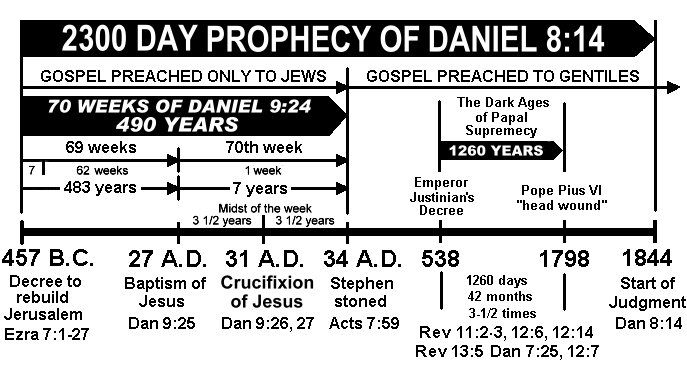
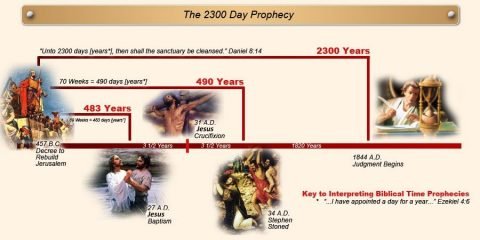
The period from the going forth of the command until “Messiah the Prince” is “seven weeks, and threescore and two weeks,” which is a total of 69 weeks, or 483 years. If we end this period in 27 AD, when Christ began his public ministry, was baptized and hence officially becomes the “anointed one,” the Messiah, it begins in 457 BC (there is no zero year).
This takes us back to the reign of Artaxerxes, as described in the biblical book of Ezra, particularly the seventh chapter of that book; the decree described there must be the one that Gabriel pointed out to Daniel. Ezra 7:8 tells us, “They arrived at Jerusalem in the fifth month of the seventh year of the king’s reign.” Historians believe that Artaxerxes’ father, Xerxes, was murdered in 465 BC, by the commander of his palace guard, but Artaxerxes did not become king until 464, which would make his seventh year 457. William Shea has produced a more detailed discussion of this dating.
Gabriel’s prophecy has a non-linear, or what we might loosely call “chiastic,” structure; it does not go in chronological order. The structure is: JTJT—Jesus, Titus, Jesus, Titus. The Jesus part is this: J2: “And he shall confirm the covenant with many for one week, and in the midst of the week he shall cause the sacrifice and the oblation to cease.” How?: J1: “shall Messiah be cut off, but not for himself.”
Jesus began his public ministry in 27 AD, but it did not last the full week, the full seven years; Jesus was “cut off” in the middle of the week, dying on the cross after 3 and 1/2 years of public ministry, in the spring of 31 AD.
But He was “cut off” not for Himself but on our behalf, so that we could be saved. His death on the cross fulfilled the Old Testament system of substitutionary, expiatory sacrifices, which were brought to the sanctuary. The great substitutionary sacrifice necessary to save fallen sinners was Jesus’ death on the cross.
And, of course, this was how Jesus “caused the sacrifice and oblation to cease.” Christ having made the real sacrifice, it no longer needed to be typified by the sanctuary system of lambs and other animal sacrifices. “These are a shadow of the things that were to come; the reality, however, is found in Christ.” Col 2:17. Type had met anti-type.
Gabriel’s prophecy given to Daniel revealed that Christ, the Messiah, would be crucified and cause the sacrificial system to cease in its symbolic importance in the spring of A.D. 31. These predictions were fulfilled in every detail. Exactly at Passover, when the high priest was offering the Passover lamb, Christ was sacrificed for us.
The 490 years that were appointed or decreed for the Jewish nation came to a close in 34 AD, with the stoning of Stephen; that is when their national probation ended. The gospel, and all the “oracles of God”—the patrimony of the Hebrew Scriptures—were then given to the gentiles. We see a vivid picture of God’s patience in giving the Jews almost half a millennium of additional probation after their captivity in Babylon. God never gives up on anyone or any group of people too soon.
Terrible things were soon to happen. Now we enter the Titus part of the prophecy: T1: “and the people of the prince that shall come [Titus] shall destroy the city and the sanctuary; and the end thereof shall be with a flood, and unto the end of the war desolations are determined.” T2: “and for the overspreading of abominations he [Titus] shall make it desolate, even until the consummation, and that determined shall be poured upon the desolate.
This prophecy saw its fulfillment in 70 AD with the destruction of Jerusalem, “the city,” and Herod’s Temple, the Second Temple, “the sanctuary.” Jesus pointed out that “the abomination of desolation written about by the prophet Daniel” would be fulfilled when the Roman armies surrounded Jerusalem:
“When ye therefore shall see the abomination of desolation, spoken of by Daniel the prophet, stand in the holy place, (whoso readeth, let him understand). Then let them which be in Judaea flee into the mountains. Let him which is on the housetop not come down to take any thing out of his house. Neither let him which is in the field return back to take his clothes.” Mat. 24:16-18.
“But when you see Jerusalem surrounded by armies, you will know that her desolation is near.” Luke 21:20
The prophecy that Gabriel told Daniel, recorded in Daniel 9, was fulfilled very exactly in the time-frame specified. Thus, we know that 457 BC is the right date to start the 490 years. But is it also the right date to begin the 2,300 years, which would then end in 1844?
Gabriel tells Daniel that 490 years are “cut off” (Hebrew chathak) for the Jewish people. Cut off from what? Adventists have traditionally argued that the 490 years were the first portion of the 2,300 years; i.e., they were “cut off” from the 2,300 years. Since the 490 years are a subsequently given time prophecy, it makes since that they would link back to the time prophecy of Daniel 8:14. It also stands to reason that, because no starting date was given for the 2,300 years, the starting date specified for the 490 years should also apply to the 2,300 years as well.
But, ultimately, the final rationale is that it just fits. We know from Daniel seven that the judgment in heaven cannot begin until the little horn power is established, and until he has persecuted the saints for 1,260 years, ending in 1798. Thus a date that ends in 1844 fits the whole prophetic scheme of the book of Daniel.