

Did you know that the angel Gabriel told Daniel that his people, the Jews, would be given a probationary period of 490 years to get their act together? True story! While the Jews were still captives in Babylon, God’s messenger told Daniel that “his people” were being given 490 years, and then the Messiah would come.
Few understand that the Seventy weeks prophecy is both a final probation for the Jews as a nation, and a clear prediction of exactly when the Messiah would appear on earth, and what He would do.
The Continuing Decline of Carnal Israel
In noting that God has already fulfilled his land promises to Israel, we briefly summarized the history of Israel in the promised land, the land God promised to Abraham, from the Exodus to the scattering of the ten northern tribes in 722 BC. That latter date, 722 BC, was really the end of carnal Israel in its fullest sense, when it consisted of all twelve tribes, all of the descendants of Jacob, who was renamed Israel.
The southern kingdom, consisting of the tribes of Judah and Benjamin, continued on after the northern 10 tribes were swept away. Most of the kings of the southern kingdom were evil, leading the people into idolatry and gross immorality. But because a few of the southern kings, such as Jehoshaphat, Hezekiah, and Josiah, were godly men who ruled in the fear and admonition of the Most High—whereas all of the northern kings, without exception, were evil—the southern kingdom held on for another 135 years after the northern kingdom was destroyed.
Nevertheless, despite the prophets and the good kings, Judah’s wrong course continued. In 586 BC, King Nebuchadnezzar of Babylon destroyed Jerusalem, and with it Solomon’s great temple, which had stood for four centuries. Most of the people were taken into captivity in Babylon.
But even while the Jews were still in Babylon, God had a special message for Daniel about his people and their coming Messiah.
The Seventy Weeks Prophecy
When the Prophecy was Given
Daniel Nine begins with this statement from Daniel:
“In the first year of Darius son of Xerxes (a Mede by descent), who was made ruler over the Babylonian kingdom— in the first year of his reign, I, Daniel, understood from the Scriptures, according to the word of the Lord given to Jeremiah the prophet, that the desolation of Jerusalem would last seventy years.” Dan. 9:1-2.
Darius the Mede was the first ruler of Babylon after the Medo-Persian empire conquered Babylon in 539 BC (see, Daniel 5). Cyrus the Great led the army that conquered Babylon. Hence the first year of his Darius’ reign over Babylon was 539 to 538 BC. [See note]
Jeremiah’s prophecy of 70 Years of Babylonian Captivity
Daniel had been studying the writings of the Jeremiah, who had prophesied that Jerusalem would lie desolate or empty for 70 years (see, Jeremiah 25:11; 29:10). If we start the 70 years of desolation in 586 BC, when Babylon destroyed Jerusalem, they end in 516 BC. So when Daniel was writing this, in 538 BC, the Babylonian captivity still had over 20 years remaining to run.
Recall that Daniel had been a youth when Jerusalem fell (see, Daniel 1) and had already spent almost half a century of captivity in Babylon. He was now an old man. Likely, the discouraging realization that the prophesied date for the return to Jerusalem was still a long way off prompted him to pray a very fervent and heart-felt prayer that the 70 years would be cut short.
Daniel’s Prayer
This prayer is found in Daniel 9:4-19. In it, Daniel acknowledges that Judah had sinned, and that the destruction of Jerusalem had been a divine judgment on Judah for their disobedience. Daniel nevertheless asks God to have mercy on Jerusalem, not because the Jews deserved it, but out of God’s own mercy:
“So now, our God, accept the prayer and requests of your servant, and show favor to your devastated sanctuary for your own sake. Listen attentively, my God, and hear! Open your eyes and look on our desolated ruins and the city called by your name. For it is not because of our own righteous deeds that we are praying to you but because your compassion is abundant.” Dan. 9:17-18
God did not even wait for Daniel to finish his prayer! God could not bear to leave the dearly beloved Daniel in suspense, so He sent the angel Gabriel to Daniel in mid prayer! If you ever wonder whether God hears your prayers, wonder no more. He does.
“While I was speaking and praying, confessing my sin and the sin of my people Israel and making my request to the Lord my God for his holy hill— while I was still in prayer, Gabriel, the man I had seen in the earlier vision, came to me in swift flight about the time of the evening sacrifice. He instructed me and said to me.
“Daniel, I have now come to give you insight and understanding. As soon as you began to pray, a word went out, which I have come to tell you, for you are highly esteemed.” Dan. 9:20-23.
The Vision of the 70 Weeks
And here is what God instructed Gabriel to tell Daniel:
Therefore, consider the word and understand the vision:
Seventy weeks are determined upon thy people and upon thy holy city, to finish the transgression, and to make an end of sins, and to make reconciliation for iniquity, and to bring in everlasting righteousness, and to seal up the vision and prophecy, and to anoint the most Holy.
Know therefore and understand, that from the going forth of the commandment to restore and to build Jerusalem unto the Messiah the Prince shall be seven weeks, and threescore and two weeks: the street shall be built again, and the wall, even in troublous times.
And after threescore and two weeks shall Messiah be cut off, but not for himself: and the people of the prince that shall come shall destroy the city and the sanctuary; and the end thereof shall be with a flood, and unto the end of the war desolations are determined.
And he shall confirm the covenant with many for one week: and in the midst of the week he shall cause the sacrifice and the oblation to cease, and for the overspreading of abominations he shall make it desolate, even until the consummation, and that determined shall be poured upon the desolate.
Note that God, through Gabriel, did not answer Daniel’s immediate concern for the return of the exiles and the rebuilding of the temple. He did not promise to cut short the 70 years. His solemn decree of judgment would be fulfilled just as Jeremiah had prophesied.
The Decree of Cyrus the Great
But something wonderful happened that very year, 538 BC: Cyrus issued a decree allowing the temple in Jerusalem to be rebuilt. See, 2 Chron. 36:22-23; Ezra 1:1-4.
“This is what Cyrus king of Persia says:
“‘The Lord, the God of heaven, has given me all the kingdoms of the earth and he has appointed me to build a temple for him at Jerusalem in Judah. Any of his people among you may go up to Jerusalem in Judah and build the temple of the Lord, the God of Israel, the God who is in Jerusalem, and may their God be with them. And in any locality where survivors may now be living, the people are to provide them with silver and gold, with goods and livestock, and with freewill offerings for the temple of God in Jerusalem.’”
Reconstructing the temple took 22 years—it was finished in 516 BC (Ezra 6:14-16)—so God’s decree through Jeremiah of 70 years of desolation was exactly fulfilled, from 586 to 516 BC. Yet Daniel also had the assurance, because of Cyrus’ decree, that the temple would be rebuilt.
We see that God’s justice is always mingled with His mercy; His justice was the decree of 70 years of desolation without a temple, His mercy was in allowing the Jews a head start on the return and rebuilding, and letting the aging Daniel know that the temple would certainly be rebuilt.
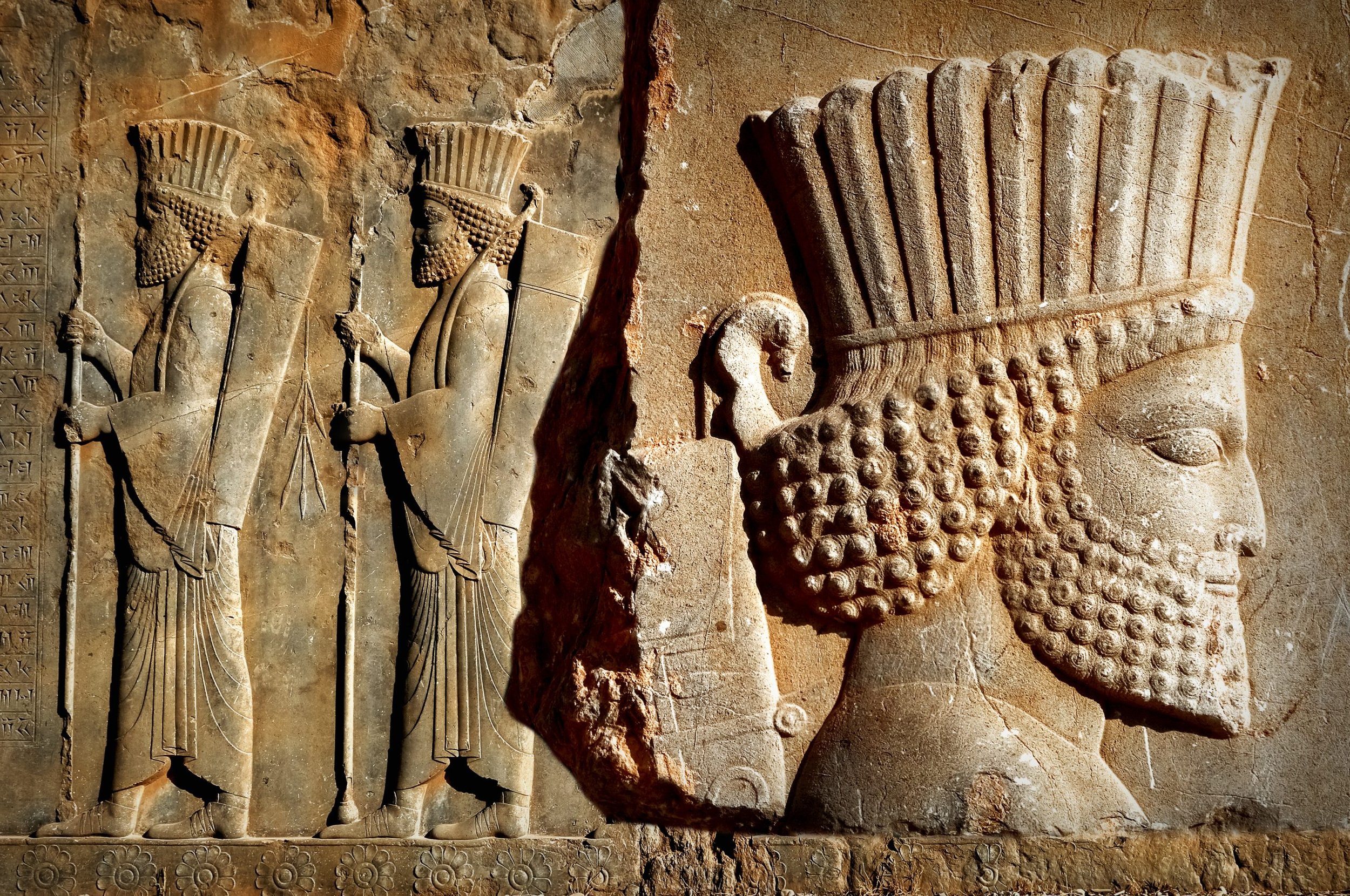
Cyrus the Great
God gave Daniel More than he asked for!
But God also chose to answer much more than Daniel had asked—which reminds me of Ephesians 3:20: “Now to him who is able to do immeasurably more than all we ask or even imagine.”
God decided to give Daniel the larger picture of the final fourth of Israel’s time as God’s covenant people. He would tell Daniel how many years were left for the Jews, when the long expected Messiah would come, and when the second temple and the city of Jerusalem would be destroyed.
Outline of the 70 Weeks Prophecy
The seventy weeks prophecy is one of the most important and profound prophecies in the Bible. It has many facets, including:
1) it sets a time limit on the probation of the Jewish nation and their city, Jerusalem,
2) it is clearly a Messianic prophecy, pointing forward to Jesus Christ, stating that the time period reaches unto, “Messiah the Prince,” and stating that “Messiah would be cut off, but not for Himself” a clear reference to Christ’s sacrificial death on our behalf,
3) the 70 prophetic weeks, or 490 literal years, begin in 457 BC and end in 34 AD,
4) the 70th and final prophetic “week”—literally seven years—begins with the Baptism of Jesus Christ in 27 AD. This was when Jesus became the Messiah or “anointed one,” as indicated by the Holy Spirit descending as a dove at His baptism,
5) In the midst of the final “week,” in the spring of 31 AD, Jesus is “cut off, but not for Himself.” His sacrificial death on our behalf causes “the sacrifice and the oblation to cease”; the temple sacrifices that pointed forward to the Messiah are fulfilled by Christ, and cease to be necessary or acceptable,
6) the 70th and final week comes to an end in 34 AD, with the stoning of Stephen. Before that event, the gospel was preached in Jerusalem to the Jews, but after the stoning of Stephen, the gospel is to go to the gentiles and the whole world, and
7) although the Jews’ probation comes to an end in 34 AD, God grants them an additional 36 years before meting out His judgment. But at last, “the people of the prince that shall come shall destroy the city and the sanctuary,” the prince being Titus, the son of the Emperor Vespasian, who destroyed Jerusalem, including Herod’s magnificent temple, in 70 AD. “For the overspreading of abominations he shall make it desolate,” an event that Christ clearly identifies as the Roman destruction of Jerusalem.
All this and more is in the 70 Weeks prophecy!
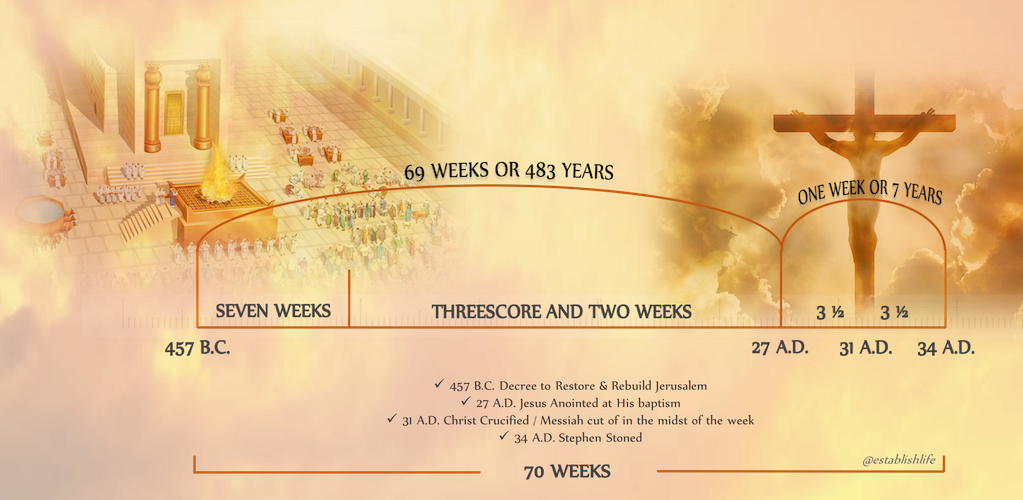
A correct understanding of the 70 weeks prophecy is necessary for several purposes related to debunking the false and heretical beliefs of the dispensationalists/Christian Zionists. It teaches that the Jews’ time as God’s chosen, covenant people came to a definite end in 34 AD, marked by the stoning of Stephen. The severe judgment to be meted out to the tenants who killed the landlord’s son was delayed for another 36 years, until 70 AD. But finally, the “abomination of desolation” spoken of by the Prophet Daniel came to pass.
Adventist apologists have focused on tying the beginning of the 70 weeks which, when placed in 457 BC, have an obvious Messianic ending point, to the beginning of the 2,300 days prophecy. The latter prophecy was interpreted by William Miller to mean that the Second Advent would take place in 1843, later 1844, but our pioneers re-interpreted it as pointing to the beginning of the investigative judgment in heaven. As thus re-interpreted, the ending of the 2,300 days is not marked by any momentous, earthly, visible event—hence the pressing need to tie the 2,300 days to the 70 weeks.
This preoccupation with our parochial eschatological concerns has tended to cause Adventists to skate over the substance of the 70 weeks prophecy, when we ought to study it closely for its own sake. In Part 2 of this series, I intend to study it for its own sake.
Stay tuned for Part 2!
_______________________
[Note] Darius the Mede is mentioned three times in the book of Daniel: First, he conquered Babylon on the night of Belshazzar’s feast, at which Daniel read and interpreted the famous “handwriting on the wall” (Daniel 5:30-31). Second, he is the king who was deceived into enacting a law prohibiting Daniel’s prayer habits, which Daniel ignored, leading to his being thrown into the Lion’s Den (Daniel 6). Third, he is cited as the ruling monarch when Daniel was given the vision of the seventy weeks, in 539-538 BC (Daniel 9:1-2).
But no “Darius the Mede” is mentioned (by that name) in any extra-biblical sources. To deepen the mystery, Cyrus the Great is recorded as ruling the Persian Empire during that same year, 539 to 538 BC (in fact, Cyrus issued the 538 BC decree allowing the Jews to begin rebuilding the temple in Jerusalem).
Most conservative scholars have concluded that Darius and Cyrus were two different men who divided the governing responsibilities. The ancient sources state that Darius was Cyrus’ uncle (and Cyrus was Darius’ nephew).
Jerome of Stridon (ca. 344 – 420 AD), also known as Hieronymus, wrote, "He [Daniel] calls Darius, Cyrus's uncle, a ram. He reigned over the Medes after his father, Astyages. And the one horn which was higher than the other, and growing still larger [Daniel 8:3] signified Cyrus himself, who succeeded his maternal grandfather, Astyages, and reigned over the Medes and Persians along with his uncle, Darius, whom the Greeks called Cyaxeres."
Jerome’s mention of “the Greeks” is likely a reference to Xenophon (c. 430 – 355/354 BC), the Greek general, philosopher, and historian, who wrote a partly fictionalized biography of Cyrus the Great called the Cyropaedia. Xenophon wrote that Cyaxeres (Darius the Mede) was Cyrus’s uncle, and that Cyrus was the grandson of Astyages.
Ellen White endorses the view that Cyrus was Darius nephew, writing, “It was not long before reverses came. Babylon was besieged by Cyrus, nephew of Darius the Mede, and commanding general of the combined armies of the Medes and Persians.” Prophets and Kings, p. 523.
