


The other day SDA Pastor Ivor Myers published a viral post calling public criticism of the church “satanic”.
His gripe, it seems, isn’t particularly about having issues with the church but rather with discussing them in public forums where “unbelievers” could potentially have access to our dirty laundry.
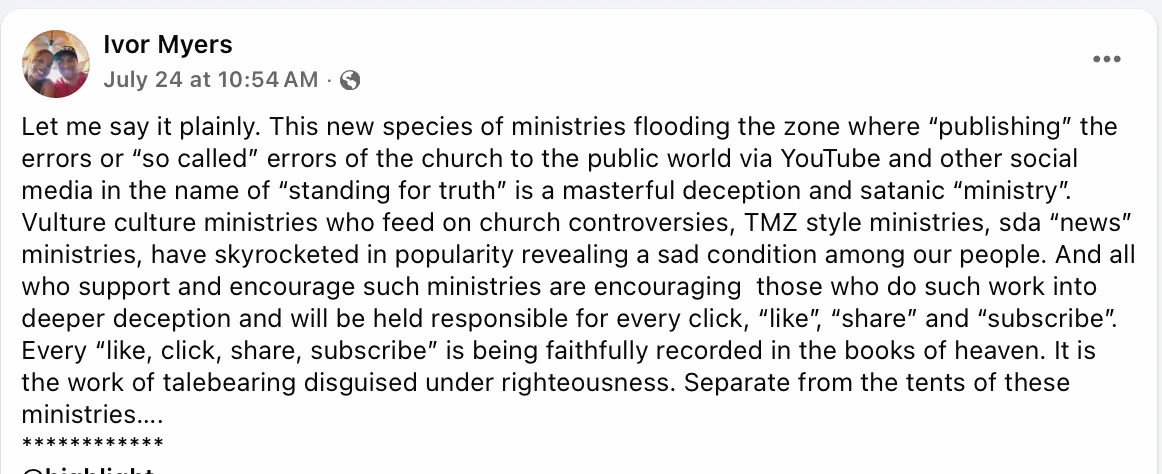
To tell you the truth, I was conflicted when I read the post.
Because on one hand, I’m asking myself, “Isn’t this the same guy who tried to convince people that an entire time signature in music was monopolized by the devil -- his only credibility being that he’s a former rapper? Can we trust the opinion of someone whose logic is questionable?”
And on the other hand, I’m thinking, “He’s right. Some people do seem to feed off controversy, and the conversations they bring into the spotlight seem to have little to do with elevating the SDA culture.”
But then I started to ask myself:
Why do so many SDA leaders seem so threatened by public criticism?
And what if instead of viewing it as a personal attack, treason, or betrayal – what if they started viewing it as a signal? What if they viewed it as an opportunity, even?
Take for example, this Instagram video that two people in my circle sent me recently.

The young woman in the video explains that although she grew up in the Seventh-day Adventist Church, she developed a much deeper understanding of the importance of having a relationship with God after attending Sunday-worshipping churches as an adult. She describes finding a culture of fellowship, community, and genuine connection that she says she rarely experienced growing up Adventist.
She also says/hinted that she feels the Adventist Church, in general, is “outdated,” resistant to fresh ideas, and disconnected from the needs of young people.
Now, if you’re a leader watching something like this, you have a choice.
You could get offended and mentally begin listing every youth program your conference has ever organized.
Or...
You could see it as an opportunity.
This thing got more than 14K likes and 1,314 reshares. So clearly the message resonated with many people.
As a leader, that’s your signal. That’s your opportunity to understand how many people are really feeling and to respond with compassion – not criticize them for having opinions or sharing their experiences.
What if a video like this prompted you to:
Create an anonymous survey for the young people in your church asking them to react to the video and share what would help them feel more connected to your local church family.
Pivot your upcoming Sabbath sermon, using the conversation as a starting point to explore practical ways we can create deeper relationships within the church.
Reach out to local social workers and youth counselors to better understand the biggest struggles young people in your community are facing, then create sermons, Bible studies, or social media content that speaks directly to those realities.
Would that make you a weak leader who caves to criticism? Or a thoughtful leader who leverages it as an opportunity to better serve the people entrusted to your care?
You know, the Ivor Myers characters among us might argue that these conversations should remain internal.
And honestly?
In an ideal world, I might even agree.
But let’s be real.
When we do have these conversations internally, how often does anything actually change?
I think about the countless “strategic plans” to reach young people. Yet when it’s time to make decisions, there often isn’t a single young person sitting at the table. And if there are young people involved, they often seem to be the ones selected by the establishment because they already fit a particular mold.
The result? Little diversity of thought and the same, old patterns of ministry struggling to survive in a rapidly changing world.
I think there’s hope though. But it requires a different mindset.
Think of it this way:
If the church were a business and someone left a negative online review after a bad experience, we’d follow many of the same customer service principles successful organizations use every day. We’d respond thoughtfully. We’d try to understand what happened. We’d evaluate whether there were legitimate issues buried beneath the frustration. We’d use that feedback to improve the experience for the next person.
Ok…So, why don’t we approach criticism of the church the same way?
Of course, not every criticism has merit. Some complaints are unfair. Some people are simply looking for attention. But as an organization that’s supposed to be focused on people and can’t survive without people, I would argue that the burden falls on leaders to thoughtfully evaluate criticism before dismissing it outright. Interestingly enough, Scripture gives us a model for this.
In Acts 15, the early church found itself in the middle of a serious disagreement over Gentile converts. Some believers insisted that Gentiles needed to be circumcised and keep the law of Moses. Paul and Barnabas strongly disagreed, and eventually the issue was brought before the apostles and elders in Jerusalem.
What strikes me is what happened next.
They didn’t pretend the controversy didn’t exist. They gathered. They listened. They debated. Peter spoke about what he had witnessed among Gentile believers. Paul and Barnabas shared what they had seen God doing in their ministry. James weighed the testimony and Scripture. And ultimately, the church changed its approach, deciding not to place requirements on Gentile believers that its leaders concluded God wasn’t asking of them.
The controversy wasn’t treated as an enemy of the church. It became an opportunity for the church to listen, discern, clarify, and grow.
And no, Acts 15 doesn’t give us some sanitized picture of leaders who suddenly became perfect at handling disagreement. By the end of the chapter, Paul and Barnabas themselves have such a sharp disagreement over John Mark that they part ways. These were still very human people.
But that doesn’t make the earlier example less meaningful. In fact, we learn that Scripture doesn’t require leaders to be conflict-free. It shows us that when an issue affecting the people they serve comes to the surface, they can choose to engage it thoughtfully rather than simply silence it. And to me, that is a very different posture than simply labeling public criticism as “satanic.”
Maybe the bigger question isn’t whether criticism belongs on Facebook, Instagram, or behind closed doors. Maybe the bigger question is this:
When people tell us they’re struggling, what do we do with that information?
We can dismiss it because it was shared in the “wrong” place. We can question the motives of the person speaking. Or we can ask whether God might be using uncomfortable voices to reveal blind spots we’ve stopped seeing.
Not every criticism will be valid. Not every complaint deserves action. But if we’re serious about reaching people, shouldn’t we be just as interested in understanding why people are leaving as we are in convincing them to stay?
Because sometimes criticism isn’t an attack.
Sometimes it’s a signal.
And faithful leaders don’t just defend the mission. They listen carefully enough to strengthen it.
****

Wyndi Ambrose lives in Christiansted, US Virgin Islands with her husband Salvador Felix and two children. A thoughtful writer, Wyndi operates a Substack titled Reverent Questions. She writes in her spare time, (when the children are alseep).
