

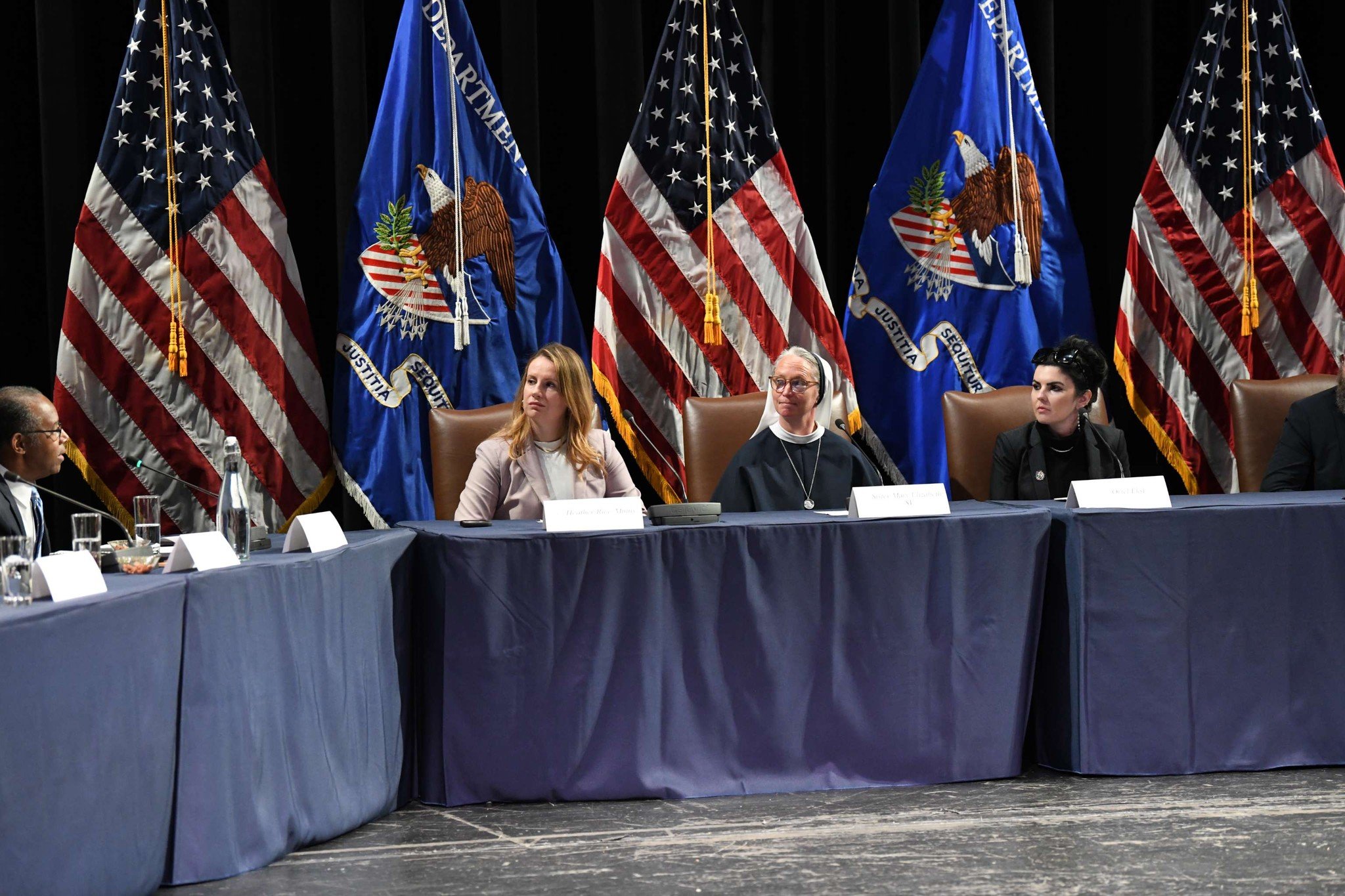
The Religious Liberty Commission (RLC) is a federal advisory body established by the President via executive order in May 2025. It is chaired by Texas Lt. Gov. Dan Patrick (with Dr. Ben Carson as vice chair) and includes various faith leaders and public figures. Its job is to examine the foundations and current state of religious liberty in America, identify threats to it, and make policy recommendations to the White House—particularly on protecting free exercise of religion. This is something we can support. Maybe.
Recent concern stems from the commission's final hearing on April 13, 2026, at the Museum of the Bible in Washington, D.C. During that session, Chair Dan Patrick stated:“It is time to set the record straight:
“There is no such thing as ‘separation of church and state’ in the Constitution. For too long, the anti-God left has used this phrase to suppress people of religion in our country.”
He and other participants argued that the phrase has been weaponized to restrict religious expression in public life, schools, government, and elsewhere, and that witnesses across the commission's hearings described it as eroding God-given rights. Patrick suggested recommendations like posting notices in schools and businesses affirming religious liberty protections while calling the separation idea “the biggest lie that’s been told in America since our founding.”
Constitutional Facts
It is true that the exact phrase “separation of church and state” does not appear in the U.S. Constitution. It originates from Thomas Jefferson’s 1802 letter to the Danbury Baptist Association, where he described the First Amendment as building “a wall of separation between Church & State.”
The Establishment Clause and Free Exercise Clause of the First Amendment states:
“Congress shall make no law respecting an establishment of religion, or prohibiting the free exercise thereof…”
This prohibits the federal government from doing two things:
Establishing an official national religion (or compelling support for one).
Prohibiting individuals or groups from freely exercising their religion.
Our Founders (many influenced by experiences with European state churches) sought to prevent the kind of religious coercion and persecution common in places where church and state were fused—such as mandatory tithes, religious tests for office (banned in Article VI), or government favoritism toward one denomination. We saw this in historical technicolor during the Dark Ages, where the Roman Church tried to control the conscience of men. This of course led to the Reformation, where the bright lights of liberty of conscience and biblical fidelity were restored, piercing the darkness.
At the same time, most early Americans assumed a Christian cultural backdrop, with religion playing a visible role in public life (e.g., chaplains in Congress, references to God in founding documents, state-level religious establishments that persisted into the early 19th century until the 14th Amendment’s incorporation doctrine applied the Bill of Rights to the states).
The Core Debate
The disagreement is not usually about whether government can create a national church (virtually no one serious supports that).
How much “separation” is required?
Critics of the strong “separation” view (like the RLC participants) argue that modern interpretations—often via Supreme Court rulings from the mid-20th century onward—have gone too far, treating any public acknowledgment of religion, faith-based social services, school prayer/voluntary religious expression, or religious symbols on public property as unconstitutional “establishment.” They see this as hostility to religion rather than neutrality, effectively creating a public square where secularism or godlessness is privileged. They react to the term, hearing ‘Separation of God and State’ in it. I do agree, this viewpoint goes too far, in some cases making faith in Christ or God a bad thing for administrative leaders. The Bible doesn’t support that (Daniel 6:3-4; Matthew 20:25-28).
Defenders of robust separation (including groups like Americans United for Separation of Church and State) warn that downplaying the concept risks government entanglement with religion, potential favoritism toward majority faiths (especially Christianity in the U.S. context), and erosion of protections for religious minorities, atheists, or dissenters. They fear it could lead to laws or policies that impose one group’s beliefs via state power. We also share this concern, much of it arising from our eschatological expectations.
Curiously, both sides claim to champion “religious liberty.”
One side emphasizes free exercise (protecting believers from government interference in worship, conscience, education, and speech). The other stresses non-establishment (preventing government from advancing or endorsing religion).
Supreme Court decisions have swung between these emphases over time—more tolerant in recent decades (e.g., allowing certain faith-based initiatives, school choice, or public religious displays) versus stricter separation in earlier eras.
The Founders rejected a national established church but did not envision a strictly godless or God-hostile public square. Many states had religious qualifications or support for Protestant Christianity well after ratification.
Baptists and other dissenters, like Seventh-day Adventists, are strong advocates for separation precisely to protect minority faiths from majority tyranny. This is good.
Today, concerns about “no separation” often arise from fears of Christian nationalism or theocratic tendencies, especially given the commission’s composition and venue. Conversely, many religious conservatives argue that aggressive secular enforcement (e.g., barring religious groups from public funding available to secular ones, or restricting conscientious objections) has already tilted the field against faith.
The commission plans to issue formal recommendations to the Trump administration next month on safeguarding religious liberty. These could include conscience protections, limits on government mandates conflicting with faith, school choice/parental rights in education, or challenges to certain regulations on houses of worship and religious institutions.
In short, Dan Patrick’s statement reflects a longstanding conservative critique that the “separation” metaphor has been stretched beyond the Constitution’s text and original understanding into an anti-religion tool. Whether that view leads to genuine broader protections for all faiths (including non-Christian ones) or risks new forms of entanglement will depend on the specific policies that follow. The First Amendment’s text remains the legal baseline, not Jefferson’s letter or any commission’s interpretation.
The Founders of the United States assumed that virtue—largely cultivated through religious faith and family—would restrain selfishness and make limited government possible. A government that is openly hostile to religion (treating faith as inherently suspect or dangerous in public life) risks eroding that moral capital. Recent decades have seen examples of this hostility in policy:
School policies that treat voluntary religious expression or parental opt-outs with suspicion.
Regulatory or cultural pressures that penalize conscience-based objections (e.g., in healthcare, education, or adoption services).
Observations
I believe that the government should not mandate religion. I do not believe that a government is best when it is godless or God-hostile (see Proverbs 19:2).
Many of our forefathers managed to have a Christian faith and not impose their religion on others. Roger Williams was a good example of this in Rhode Island. We are indebted to Williams for his emphasis on the distinction between our duty of God, and duty to Man.
The first four Commandments of the Decalogue define our duty to God, and the last six define how we live together in a climate for human flourishing. The government is within their rights to enforce the last Six; the first Four are hands off.
While the Constitution does not specifically mention ‘Separation of Church and State”, the 1st Amendment upholds a distinction between the two, ensuring that the government should not favor or discriminate against any religion. I believe this distinction is evident in Christ’s statement in Matthew 22:21.
When some people hear ‘Separation of Church and State” they interpret it to mean Separation of God and State. This is not good. Numerous examples of God-hostile governments litter the last century (China, Russia, Nazi Germany, Cambodia, North Korea etc).
James Madison, the chief architect of the Bill of Rights, argued that "the opinions of men" are not the proper object of civil government and warned that even mild government interference with religion would be a "flagrant usurpation."
Thomas Jefferson's "wall of separation" metaphor (in his 1802 letter) was meant to protect churches from government control and individuals from being forced to support religion against their conscience. At the same time, the Founders overwhelmingly believed that religion and morality were essential supports for republican self-government.
George Washington said in his farewell address: "Religion and morality are indispensable supports" for political prosperity. He warned that national morality could not be maintained "in exclusion of religious principle."
The end time is characterized by false religion persecuting true religion, and there are almost endless variants of false religion, from environmentalism, social justice, LGBTQ+ androgyny, to dominionism, etc.
Concerns
In my opinion, there are way too many Roman Catholics on the Supreme Court, and in politics in general. People have short memories, and often truncated understandings of history.
Trump would do well to rid himself of the influences of Paula White. If he is somehow partial to her initials (PW), he could appoint Paul Washer in her place. That would be an upgrade.
Data from groups tracking incidents show rising vandalism, arson, and threats against churches in the U.S. in recent years, alongside documented cases where government actors have demonstrated bias against certain religious viewpoints, such as the Biden administration punishing schools and organizations for resisting his pro-LGBTQ agenda. Our challenge is not to go too far the other direction.
Healthy tension looks something like this: Government cannot establish an official religion, compel belief, or punish people for their faith (or lack of it). No hostility: Government should remain neutral toward religion rather than antagonistic.
We’ll see how this goes. In the meantime, stay cool, be patient, and try to avoid panic.
In the time of the End where liberty of Conscience is threatened worldwide, panic will not help us. The spiritual fruit of patience will (Revelation 14:12; Gal. 5:22).
****
"Here is the patience of the saints: here are they that keep the Commandments of God, and the faith of Jesus" (Revelation 14:12).
